Liberalism
Critical Choices: Energy Security for Malaysia and Germany
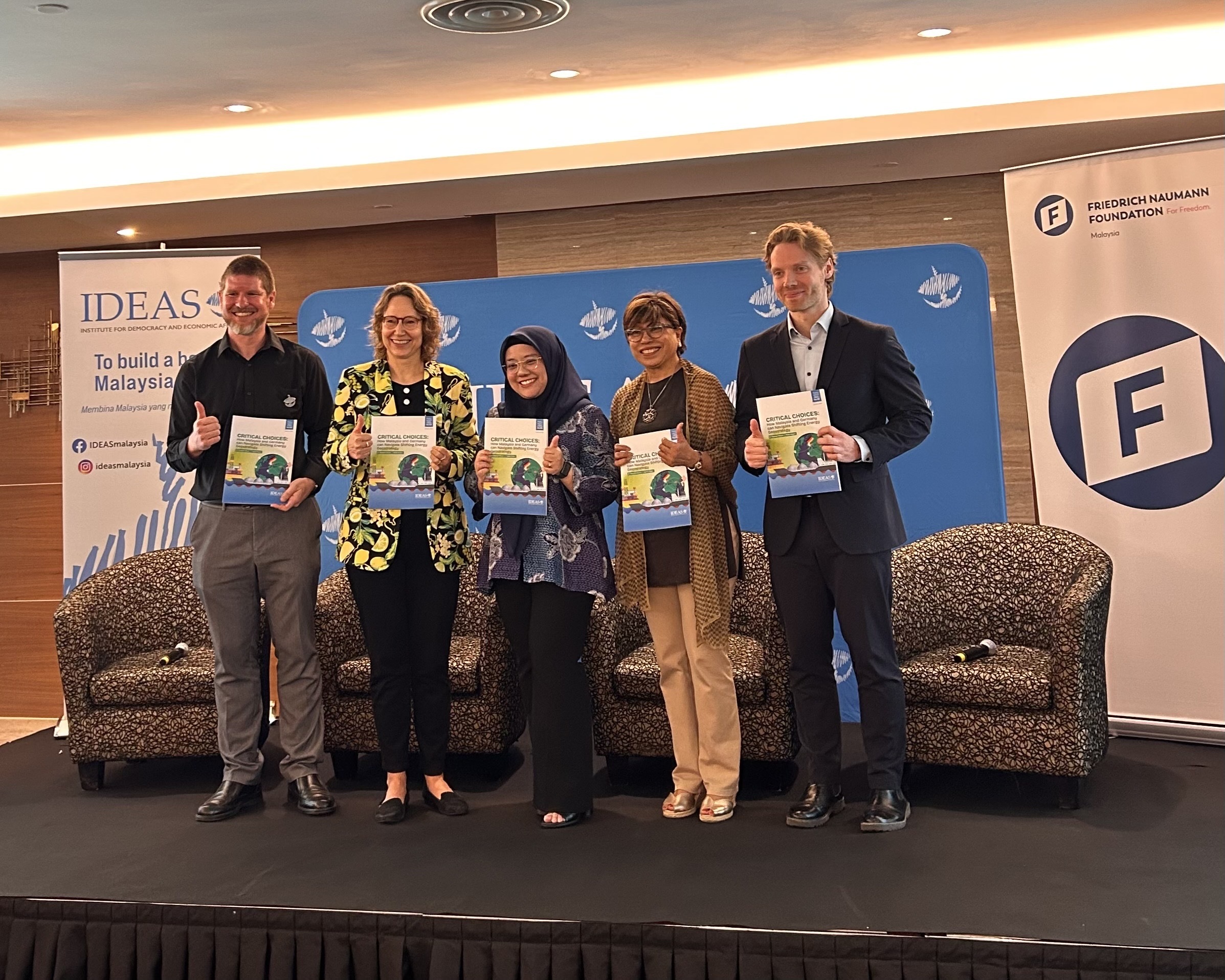
(from the left) Dr Stewart Nixon (IDEAS Director of Research), Katrin Bannach (FNF Malaysia Project Director), Aira Azhari (IDEAS CEO), Tan Sri Datuk Dr Rebecca Fatima Sta Maria (IDEAS Board Director), Malte Küper
FNF Malaysia has partnered with IDEAS on the conference, The 11th Liberalism Conference, titled "Liberty, Democracy and Resilience", took place in Kuala Lumpur on 17 October 2026. Its discussions covered geopolitical rivalry, climate change and economic fragmentation, and how liberal principles can guide practical responses to them.
Energy markets are under growing pressure. Disruptions to tanker traffic in the Strait of Hormuz add to the lasting effects of Russia's invasion of Ukraine. At the same time, US energy policy and China's dominance in green manufacturing and critical minerals are reshaping global markets.
For middle powers such as Malaysia and Germany, the challenge is to respond to these shifts without becoming dependent on any single partner.
The report Critical Choices: How Malaysia and Germany Can Navigate Shifting Energy Geostrategy was released by the Institute for Democracy and Economic Affairs (IDEAS) on 17 October 2026, alongside its Liberalism Conference 2026 in Kuala Lumpur. It was co-authored by IDEAS Director of Research Dr Stewart Nixon and Malte Küper, Senior Economist at the German Economic Institute.

Short-term fixes are not enough
Policymakers are often caught in a cycle of crisis responses. The report argues that each new shock causes more damage when governments focus on immediate pressures instead of preparedness.
It also notes that untargeted subsidies are expensive and can discourage more resilient choices. Governments need clearer strategies that weigh the trade-offs between risk, resilience and reward.
Lessons from Malaysia and Germany
The study compares the two countries' experiences. It separates differences that reflect context from those that point to gaps in policy adaptation.
The report identifies two kinds of dependency. One is the long-standing reliance on cross-border fossil fuel flows. The other is a newer reliance on the technology and products that support renewable energy production. Accelerating renewable energy installation is the most effective way to reduce the risk of disruption, according to the paper.
The report recommends that governments:
- develop clearer national strategies on energy risk, resilience and trade-offs;
- pursue bilateral and plurilateral cooperation towards binding agreements on joint preparedness;
- move from untargeted subsidies towards targeted, time-limited responses; and
- guard against both fossil fuel and renewable energy supply chain dependencies.
As Malte Küper puts it: "Energy risk lies not only in the supplier, but in whether infrastructure enables energy source flexibility. Analysis of dependence must assess the tradability of the energy source, not import shares alone."
Dr Stewart Nixon adds: "Malaysia cannot continue to rely on unsustainable and untargeted subsidies that provide temporary relief but preserve a status quo that will never return. It must work with partners like Germany to build clearer strategies, concerted preparedness efforts, and policy mechanisms for targeting support."
Why it matters
The report shows that Malaysia and Germany can learn from each other. Both countries face pressure from geopolitical rivalry and from the energy transition, and both can benefit from cooperation on preparedness and supply chains.
Read the full paper on IDEAS’ website here.