Malaysia
China’s and Russia’s Overseas Campaigns
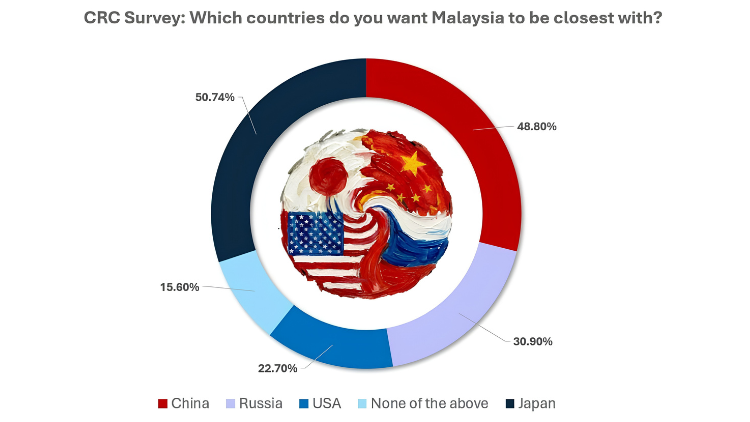
Cyfluence's report (from page 25)
© Cyfluence Research CenterThe study by the Merdeka Center (MC) is based on a nationwide survey on perceptions of global developments. The second study by the Cyfluence Research Center (CRC) analyzes digital influence vectors, foreign information manipulation and interference (FIMI). Both studies were commissioned by the Friedrich Naumann Foundation for Freedom.
Positive Image: Russia Exploits Trust in Domestic Media
A surprising finding: 47% of Malaysians view Russia as a reliable partner in defense and security policy. This is despite the fact that Russia was responsible for shooting down the Malaysian passenger plane MH17 in 2014. However, the majority of those surveyed doubt this. The reason is effective Russian state propaganda in Malaysia.
Malaysians are actually critical media consumers and are particularly sceptical of foreign media. That is why Russia and China skilfully disseminate their content through trusted domestic channels, such as the national news agency Bernama, which has cooperation agreements with Sputnik, TV BRICS, and Rossiya Segodnya and benefits from media training in Russia.
In its narrative, Russia relies on downplaying the downing of MH17 as a “tragedy”. Furthermore, Moscow uses anti-colonial rhetoric to cultivate a positive image and divert attention from critical issues. Through geopolitical symbolism, the Russian Embassy portrays the “Anglo-American axis” as a threat to Malaysia’s long-term security and sovereignty and presents itself and BRICS as an alternative.
This clever diversionary tactic to deflect attention from its own military aggression is working: only 18% of respondents hold Russia responsible for the invasion of Ukraine, while nearly 30% blame the U.S. And 55% of respondents believe that Western media unfairly disparage China and Russia. For Europe, these survey results are cause for concern. Europe needs international allies to maintain pressure on Russia.
China Focuses on Long-Term Trust
China is following a slightly different strategy than Moscow: it relies on relationship-building as a foundation and increasingly focuses on soft power tools such as student exchanges and journalism training programs. The goal is to build trust through multiple channels. Beijing presents itself in a positive light, as modern and partnership-oriented. In addition to Chinese-language newspapers, it uses digital communication channels on three levels: social media accounts run by state media (e.g., Xinhua), multilingual embassy accounts, and hyperactive, fake profiles that feign independent analysis.
As a result, 75% of those surveyed not only trust China as an economic partner, but 56% also feel inspired by China’s development model. China’s state-directed market economy under autocratic leadership appears promising. China’s image as a stable partner is bolstered by the United States’ own undermining of its foreign policy credibility under Donald Trump.
Countering the Silent Doubts About Democracy
According to the studies, democratic values are deeply rooted among Malaysians. The majority of respondents are convinced that the authoritarian systems of Russia and China do not represent a viable alternative to democratic governance. However, approximately one-third of respondents are open to autocratic governance in certain situations. There is concern that China’s polished image will lead to less tolerance of complex democratic processes and, as a result, to growing support for autocratic forms of government.
Germany and Europe are facing similar disinformation campaigns, which will become even more dangerous in the future due to AI. Digital opinion-making is particularly vulnerable to propaganda. That is why media literacy training, fact-checking, and political education are more important than ever. And greater efforts should be made to curb the spread of Chinese and Russian narratives through Europe’s domestic media market.
Europe Needs a More Distinct Identity
So far, Europe has played a secondary role in the Malaysian public’s perception, far behind China and the United States. The data shows that Malaysians view Europe and Russia in similarly positive terms. Europe’s position is often equated with the “West” and viewed as a byproduct of American policy. Given the recklessness of current U.S. foreign policy, this is proving costly. The studies show that Malaysians are increasingly sceptical of a close relationship with the U.S.
Europe must develop a clear, credible profile, urges political scientist Dr. Benjamin Barton of the University of Nottingham Malaysia in his analysis of the studies. After all, Malaysia, too, needs alternative partners for diversification and risk mitigation to protect itself from becoming overly dependent on China. The new bilateral free trade agreement between the EU and Malaysia, for which negotiations have resumed, offers an excellent opportunity to do so.
* Katrin Bannach is the Project Director of Friedrich Naumann Foundation for Freedom in Malaysia and Indonesia.