Mobility
Caught between Deutsche Bahn and Metrorail

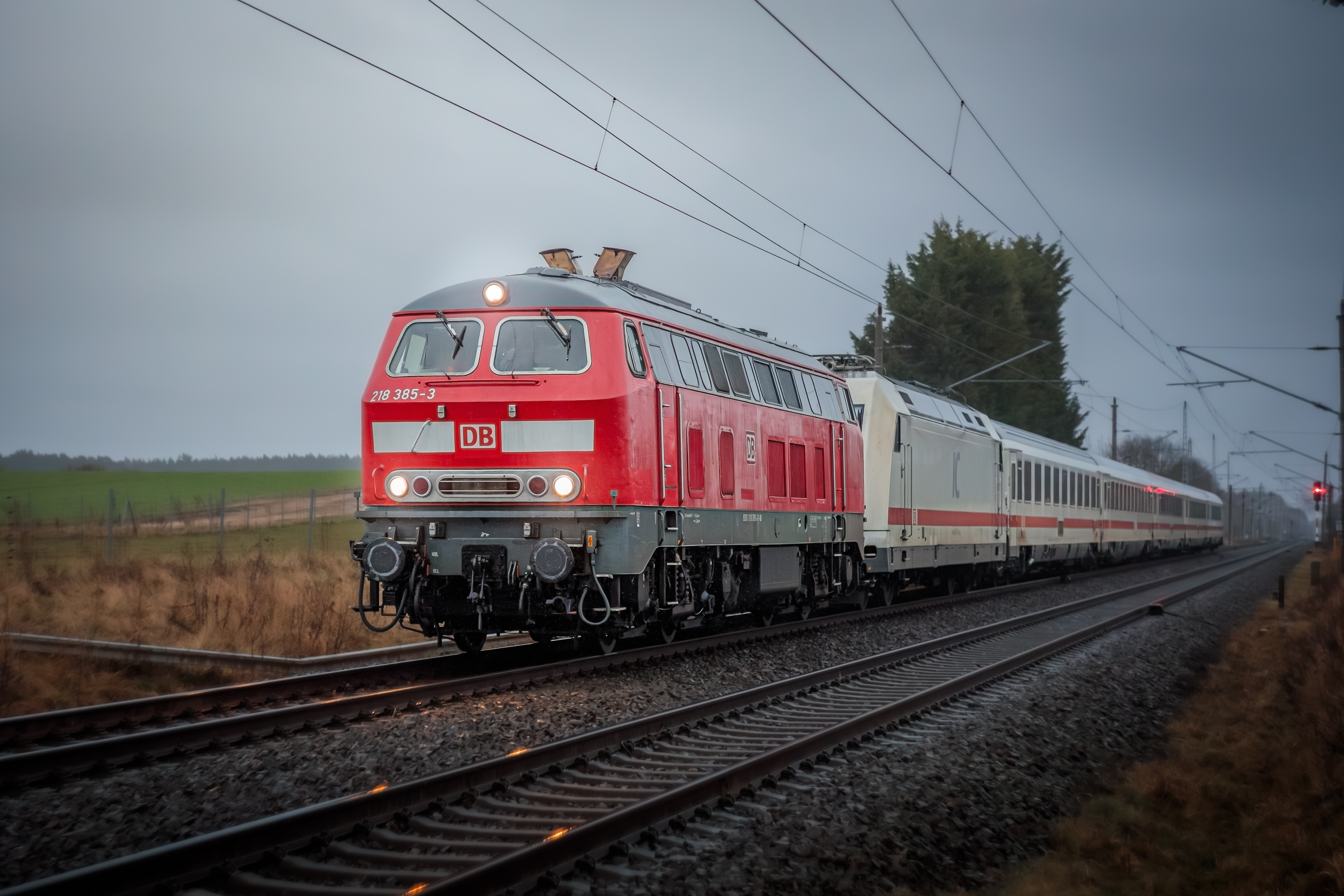
Ventschow, Germany - March 13th, 2026: Old German Diesel locomotive hauling a DB Intercity Train.
© ShutterstockGrowing up in South Africa in the early 2000s, trains were still a functional, vibrant reality. I vividly remember riding the bright yellow Metrorail network and even the less-than-pleasant memory of getting my elbow stuck in one of its automated doors. Back then, rail was the connective tissue of our society. We had the Shosholoza Meyl, that beautiful purple long-distance train that allowed passengers to commute or travel from Cape Town to Johannesburg, watching the Karoo drift by.
Today, that network is practically non-existent for everyday public transport. Decades of deliberate underinvestment, administrative neglect, and the subsequent onslaught of cable theft and vandalism completely collapsed commuter rail in South Africa. Our government treated infrastructure budgets as a cost-cutting playground, and the consequences were catastrophic.
As a South African who has travelled to Germany twice in the last six months, I am struck by a terrifying sense of déjà vu. The traditional global narrative suggests a stark contrast between "efficient Germany" and the "developing world." Yet, every time I step onto a platform managed by Deutsche Bahn (DB), a very familiar anxiety hits me. Will I make my transfer? Will I be hours late?
Just this past June, I was on an Intercity Express (ICE) train heading from Berlin to Brussels. Right as we crossed into Belgium, the train simply stopped functioning. Stranded, we had to disembark and wait for another locomotive. On the platform, I spoke with a German woman who lived near the border. She was visibly panicking. She was on her way to a friend’s 50th surprise birthday party, with a tight flight connection out of Brussels Airport. "If these delays continue," she told me, her voice tight with stress, "I’ll miss the flight. I can't afford to buy another ticket. I’ll just have to go home."
Her panic made me think: Germany is walking a path South Africans know all too well.
Germany is experiencing a crisis born of the exact same disease that killed our yellow trains: chronic public underinvestment. For years, European leaders rested on the laurels of a world-class reputation. But reputation does not maintain tracks. The legendary precision of German timekeeping is fading. When DB's network suffered a massive IT collapse that stranded thousands of travellers for hours, it exposed how deeply the government’s failure to modernize has damaged the system's reliability and public confidence.
There is a vital lesson here for Germany. Throwing billions of euros at a crumbling system now is not enough. Money alone cannot outrun time. To avoid a total structural collapse, Germany must become more radically innovative. Its slow pace in transforming into a digital society burdened by outdated administrative systems and an infamous resistance to digital banking has left its infrastructure rigid and fragile. Germany must innovate its operations, digitalize aggressively, and realize that delaying maintenance isn't a "saving" it is a debt that compounds exponentially.
Yet, as a South African, I also see a crucial lesson for my own home country.
For all of Deutsche Bahn’s frustrating delays and systemic fragility, the trains are still running. Despite late show-ups, DB's operations remain an absolute masterclass in systemic integration. The sheer ease with which a passenger can move from one side of the European continent to another via interconnected timetables is something South Africa desperately needs to emulate.
South Africa needs to urgently pick up the pace and find the political will to fix public transport. Our current approach of laying more asphalt is a fallacy; more roads will never fix congested roads. Only effective, reliable, and affordable public transport can revitalize an economy and connect a divided society. But that requires a foundational commitment to basic infrastructure, something our government has treated as an afterthought for far too long.
When governments treat public transport as a luxury to be trimmed rather than a foundational human right, society pays the price. Germany must innovate before its fragility turns into permanent ruin. South Africa must rebuild the courage to create an integrated system once more. If they don't, citizens on both sides of the equator will be left stranded on the platform, watching the future pull away.