NEWS
Women’s Political Salon: From Having a Seat to Having a Voice

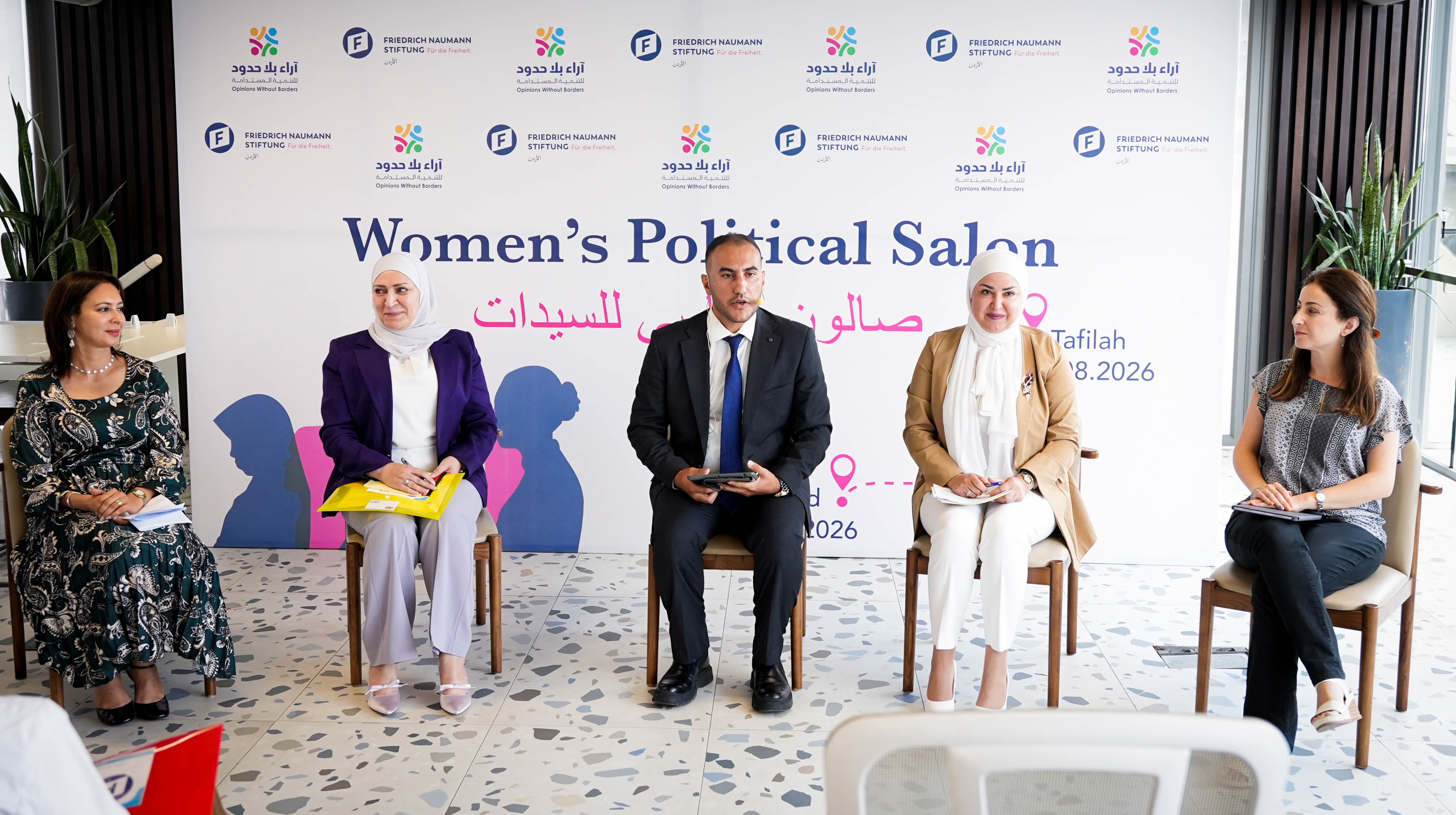
What happens after women enter politics?
Getting women into political parties, elected councils and parliament is an important achievement. But across three conversations in Irbid, Ajloun and Tafilah, women raised a more challenging question: Does representation automatically mean influence?
This question was at the heart of the Women’s Political Salon, implemented by the Opinions Without Borders Center for Sustainable Development (OWB) in partnership with the Friedrich Naumann Foundation for Freedom (FNF) Jordan.
Held on 1, 4 and 6 August 2026, the three salons brought political dialogue beyond Amman, creating spaces where women could speak directly with parliamentarians, former legislators, academics, political actors and civil society representatives about what it really takes to participate—and lead—in political life.

Beyond the Numbers
A clear message emerged: women’s political participation cannot be measured by numbers alone.
Former MP Mayada Shreim, speaking at the Irbid Salon, emphasized women’s ability to reach leadership positions while highlighting the importance of support and partnership:
“Women have proven their capabilities across different fields. Reaching leadership positions requires women to continue demonstrating their abilities, supported by mutual support among women and partnership with men in strengthening their political presence.”
Participants took the conversation further. In Irbid and Ajloun, economic independence repeatedly emerged as a key factor affecting women’s ability to enter elections, make independent political choices and sustain a public role.
As participants in Ajloun put it:
“Economic empowerment is the gateway to political participation. Financial independence strengthens a woman’s ability to run for office, make her own decisions and withstand social and family pressures.”

Joining a Party Is Only the Beginning
Political parties were another major focus. Participants questioned whether women are simply being encouraged to join parties—or whether they are actually being given opportunities to shape decisions, become candidates and reach leadership positions.
In Tafilah, speaker Mohammad Al-Ouran captured this distinction:
“The focus should be on the quality of women’s participation, not simply the numbers. Political parties must expand beyond the capital and reach women and young people in the governorates and villages.”
The discussions also brought attention to challenges that can make political participation harder to sustain, including limited access to networks and resources, as well as online harassment, stereotypes and political and digital violence.

Why Take the Conversation Beyond Amman?
Because political participation looks different depending on where you live.
Women in Irbid, Ajloun and Tafilah brought experiences shaped by their communities, demonstrating why a national conversation about women in politics must also listen to voices from the governorates.
In Ajloun, Dr. Maysoun Al-Atoum reminded participants that political participation goes beyond individual opportunity:
“Political participation is not only a right; it is a national responsibility exercised for the public good.”

Turning Voices into Policy
The salons were never intended to end when the discussions ended.
The experiences, challenges and recommendations gathered across the three governorates became the qualitative foundation for a Policy and Recommendations Paper on women’s political participation in Jordan, connecting local voices with wider evidence and policy discussions.
Importantly, the paper will not remain on the shelf. It will be officially shared with the Ministry of Political and Parliamentary Affairs (MOPPA), the Jordanian House of Representatives, and other relevant institutions and stakeholders, ensuring that the voices and recommendations emerging from Irbid, Ajloun and Tafilah can reach those involved in shaping political participation policies and practices.
And perhaps the strongest message from the three salons was simple:
Representation opens the door. The next challenge is ensuring women have the opportunity, resources and space to lead once they walk through it.
