Sharing Experience
Seeing Trade from the Other Side of the Table

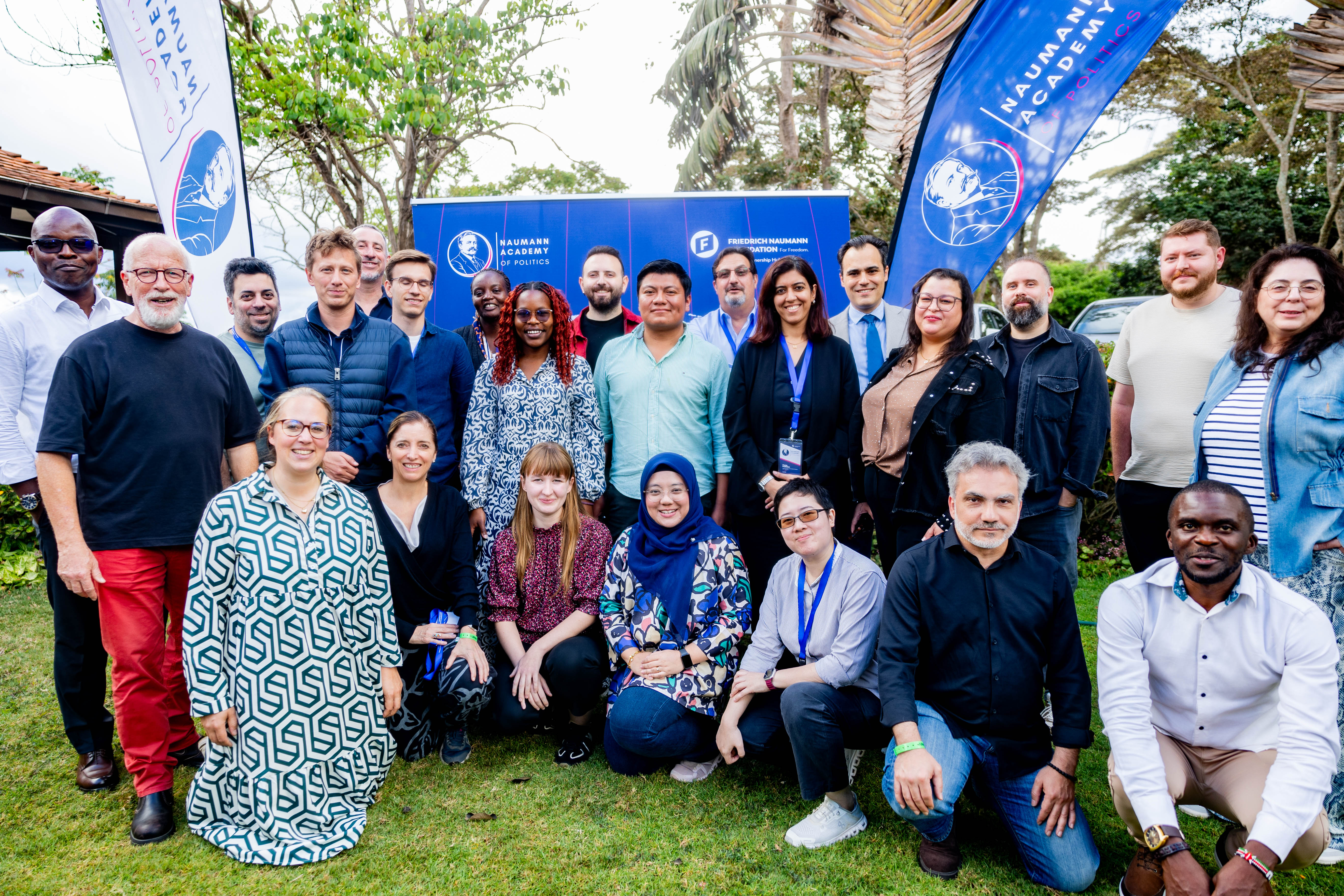
FNF seminar cohort from 19 countries.
© FNFAs a trained trade economist, I have often approached international trade through the familiar lens of comparative advantage: countries specialise in what they do relatively well, trade with one another, and collectively become better off. But as the world changes, so must our understanding of trade.
In recent years, I have often found myself wondering: Is free trade dying?
My answer today is no: free trade is not dying; it is becoming more strategic.
The picture becomes clearer when we understand how other countries and regions view the global economy, what their strategic interests are, and how they may perceive economic decisions taken elsewhere.
The seminar “Navigating the New World Order: Liberal Grand Strategy in the Age of Geopolitics”, organised by the Friedrich Naumann Foundation for Freedom in Nairobi, Kenya, helped me do exactly that.
Under the wonderful facilitation of Sven Gerst and Rainer Adam, this was not a seminar built around conventional lectures and presentations. Instead, tasks, simulations and debates kept us thinking throughout the week. Equally importantly, exchanges among participants from different countries helped us understand other economies, societies and cultures better. For a trade economist, that is invaluable. Trade does not happen between abstract economic models. It happens between countries with different histories, priorities and strategic interests.
When We Became the Strategic Decision-makers
Several times during the seminar, we were asked to make geopolitical decisions on behalf of a country or region.
Stepping into the shoes of policymakers made us confront the practical difficulties of such roles. A government has to think about its national interests, but its decisions do not exist in isolation. Decisions taken domestically can have global consequences, and other countries will interpret and respond to them through the lens of their own interests.

Presenting the European Union’s perspective during the geopolitical strategy simulation.
© FNFThis was perhaps my biggest takeaway from Nairobi: a country must consider not only its own perspective, but also how others are likely to interpret its decisions.
For someone working on international trade and competitiveness, this is particularly important today. Trade policy is increasingly intertwined with national security, supply-chain resilience, technology and industrial policy. Understanding trade therefore also requires understanding strategy.
Trade is Still a Positive-sum Game
As trade economists, we learn that trade can generate gains for participating economies. But one exercise brought this familiar idea to life in a remarkably simple way.
We were asked to assign values to items allocated to us and were then allowed to trade them with one another. As exchanges took place, the collective value of what participants held increased, a simple but powerful demonstration of how voluntary exchange can create value rather than merely redistribute it.
For me, it reinforced an important point: greater strategic competition does not mean that the fundamental gains from economic exchange have disappeared. The challenge is finding ways to preserve those gains in a world where economic and geopolitical considerations increasingly overlap.
Discovering Africa
I also realised in Nairobi how little I knew about Africa.
The discussions on the continent, its history, development challenges, resources and the growing role of external powers, including China, were a major value addition for me. Equally valuable were conversations with African participants, who brought their own experiences and perspectives to our discussions.
I returned with a stronger appreciation of Africa's growing importance in the global economic and geopolitical landscape, and of why understanding the emerging world order requires engaging seriously with African perspectives.
Finally, our visit to the United Nations Office at Nairobi and interaction with its Director-General, Zainab Hawa Bangura, provided a fitting end to these reflections. At a time when multilateralism is under pressure, the visit was a reminder that countries continue to need institutions through which they can engage, negotiate and cooperate.

Participants during a visit to the United Nations Office at Nairobi (UNON).
© FNFThe seminar strengthened my confidence that international economic cooperation is not disappearing. But its context is changing.
For me, that means looking at trade somewhat differently: not abandoning the economic logic of comparative advantage and mutual gains, but complementing it with a better understanding of geopolitics, strategic interests and, perhaps most importantly, the ability to see an economic decision from the other side of the table. This is particularly important for India as it seeks to integrate more deeply into global supply chains and strengthen its position in the global economy.

Prerna marking India on the participants’ world map.
© FNFDr. Prerna Prabhakar is a fellow at the Centre for Social and Economic Progress (CSEP).