EU-MENA
Five Political Groups, Two Draft Laws, One Parliament: The EU–MENA Simulation

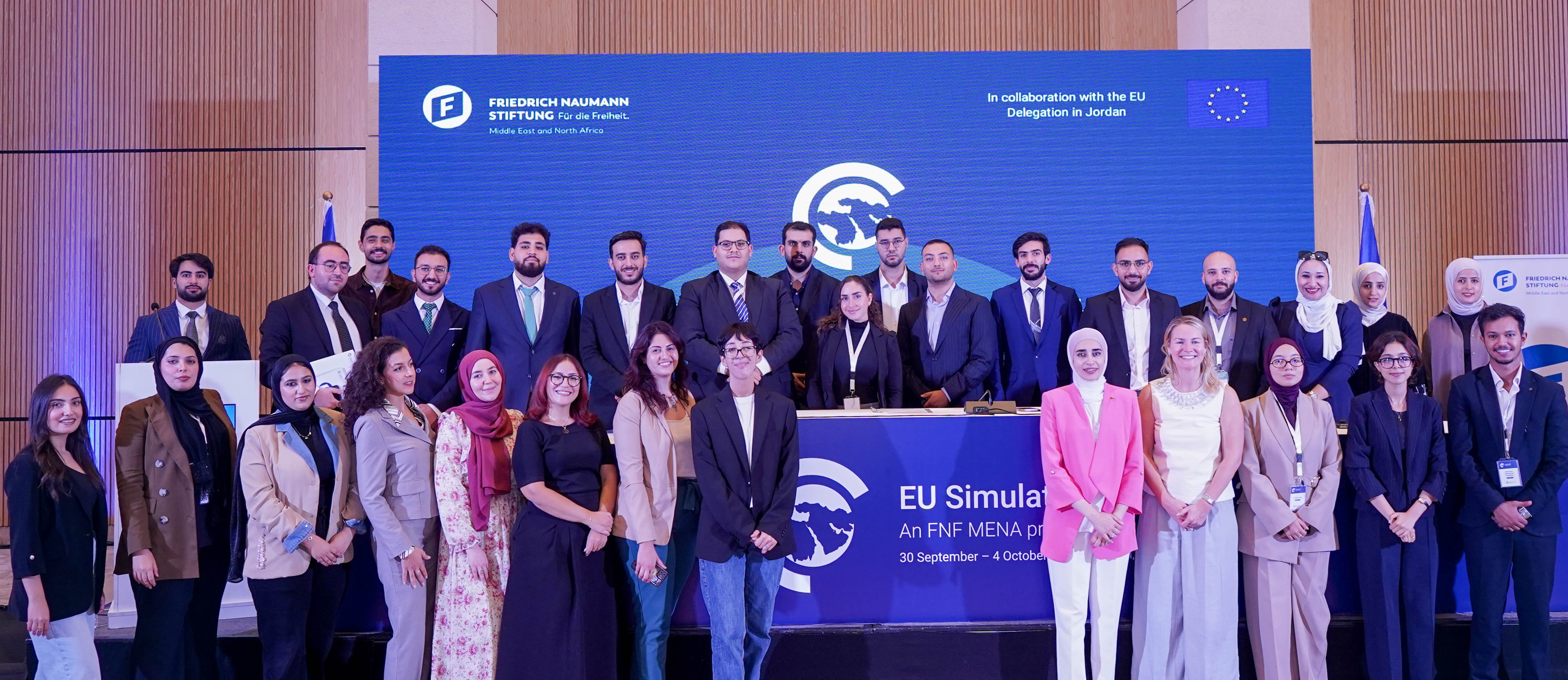
EU–MENA European Parliament Simulation 2026 | 30 September – 4 October 2026 | Amman, Jordan
What happens when young political leaders from the Middle East and North Africa step into the shoes of Members of the European Parliament (MEPs)? In Amman, 23 emerging leaders experienced European parliamentary democracy firsthand, exploring migration, political ideologies, negotiation, and the challenges of democratic decision-making.
Bringing Europe and MENA Closer Through Political Dialogue
From 30 September to 4 October 2026, the Friedrich Naumann Foundation for Freedom (FNF), through its Middle East and North Africa Regional Office, organized the EU–MENA European Parliament Simulation in Amman, Jordan, as part of the EU–MENA Political Exchange initiative.
The programme brought together 23 young political activists and emerging leaders from Jordan, Palestine, Syria, Lebanon, Iraq, Tunisia, and Morocco, creating a dynamic platform for political learning, cross-cultural exchange, and democratic engagement.
At a time when Europe and the MENA region face shared challenges related to migration, economic opportunities, and political stability, the simulation offered participants a unique opportunity to examine these issues from a different perspective: as Members of the European Parliament responsible for debating, negotiating, and voting on policies that shape relations between the two regions.
Combining expert-led discussions, diplomatic engagement, interactive learning, and a practical parliamentary simulation, the programme aimed to move beyond theoretical knowledge and allow participants to experience democratic decision-making firsthand.

Connecting Young Leaders with European Diplomacy
One of the programme's highlights was a field visit to the Delegation of the European Union to Jordan, where participants engaged in an open and interactive discussion with H.E. Pierre-Christophe Chatzisavas, Ambassador of the European Union to Jordan. The exchange offered participants an opportunity to discuss EU–MENA relations, migration, regional developments, and opportunities for stronger cooperation between Europe and the Middle East and North Africa.

Beyond gaining insights into European diplomatic perspectives, participants were encouraged to ask questions, challenge assumptions, and share their own views on issues affecting their countries and the wider region.
The programme also featured an informative session delivered by a representative of the EU Delegation to Jordan, introducing participants to the responsibilities and decision-making processes of major EU institutions, including the European Parliament, the European Commission, the Council of the European Union, and the European Council. These exchanges strengthened participants' understanding of European governance and highlighted the importance of dialogue, political representation, and international cooperation in addressing shared challenges.


Migration Beyond Borders: Understanding Different Perspectives
Migration served as the central theme of the simulation, reflecting one of the most significant and complex issues shaping relations between Europe and the MENA region.
Through interactive discussions, expert-led sessions, and group exercises, participants explored different dimensions of migration, including forced displacement, refugee protection, economic and academic migration, diaspora communities, and climate-related migration. Coming from countries with different migration experiences, participants exchanged perspectives on the political, economic, and humanitarian implications of migration.
The discussions encouraged participants to look beyond traditional narratives and consider how migration policies can balance humanitarian responsibilities, national interests, economic opportunities, and regional cooperation. The sessions also strengthened participants' communication, negotiation, and public-speaking skills, preparing them for the final parliamentary exercise.

Five Political Ideologies, One European Parliament
The highlight of the programme was the European Parliament Simulation, where participants stepped into the roles of Members of the European Parliament (MEPs), representing five different political groups inspired by Europe's diverse political landscape.
Participants were divided into five political groups: Conservatives, the Green Movement, Liberals, the Right Wing, and Social Democrats. Each group represented a distinct political perspective, with different priorities and approaches to migration, economic development, individual freedoms, environmental sustainability, and social responsibility.
Participants were challenged to understand the political values and priorities of their assigned groups and translate these perspectives into concrete policy positions. This required them to move beyond their personal opinions and approach parliamentary discussions, negotiations, and voting decisions according to the political ideologies they represented. The diversity of political perspectives created a dynamic parliamentary environment, encouraging participants to engage with opposing viewpoints, defend their positions, negotiate compromises, and build alliances across political groups.

From Parliamentary Debate to Legislative Voting
The simulation culminated in a parliamentary session during which participants debated and voted on two draft laws addressing refugee protection and organized immigration. Acting as MEPs, participants examined the proposed legislation through the lens of their assigned political groups, discussed its potential implications, and developed arguments either supporting or challenging different provisions.
The parliamentary process involved political group consultations, speeches, structured debates, negotiations, and coalition-building, reflecting the complexities of reaching agreements within a politically diverse parliament. Participants were required not only to defend their ideological positions but also to consider alternative perspectives and identify opportunities for compromise.
The exercise concluded with formal voting on both draft laws, allowing participants to experience how political positions, negotiations, and parliamentary procedures translate into legislative decisions.
More than a role-playing exercise, the simulation demonstrated how democratic institutions function when different political ideologies, interests, and priorities come together to shape public policy. It also highlighted an essential lesson: democracy is not about eliminating political differences, but about managing them through dialogue, negotiation, and respect for democratic procedures.

Building Bridges for the Future
Beyond the parliamentary exercise, the programme connected young political leaders from across the MENA region, strengthening regional networks and encouraging dialogue across political and cultural differences. The initiative reflects FNF MENA's commitment to empowering emerging political leaders, promoting liberal democratic values, and strengthening cooperation between Europe and the MENA region.
The exchange will continue with activities in Brussels in November 2026, creating further opportunities for international political engagement and networking.
The future of EU–MENA relations should not only be discussed by today's decision-makers, but also shaped by the young leaders of tomorrow.