Brazil
Brazil 2026: Artificial Intelligence, Disinformation, and the Liberal Commitment to Defending Democracy

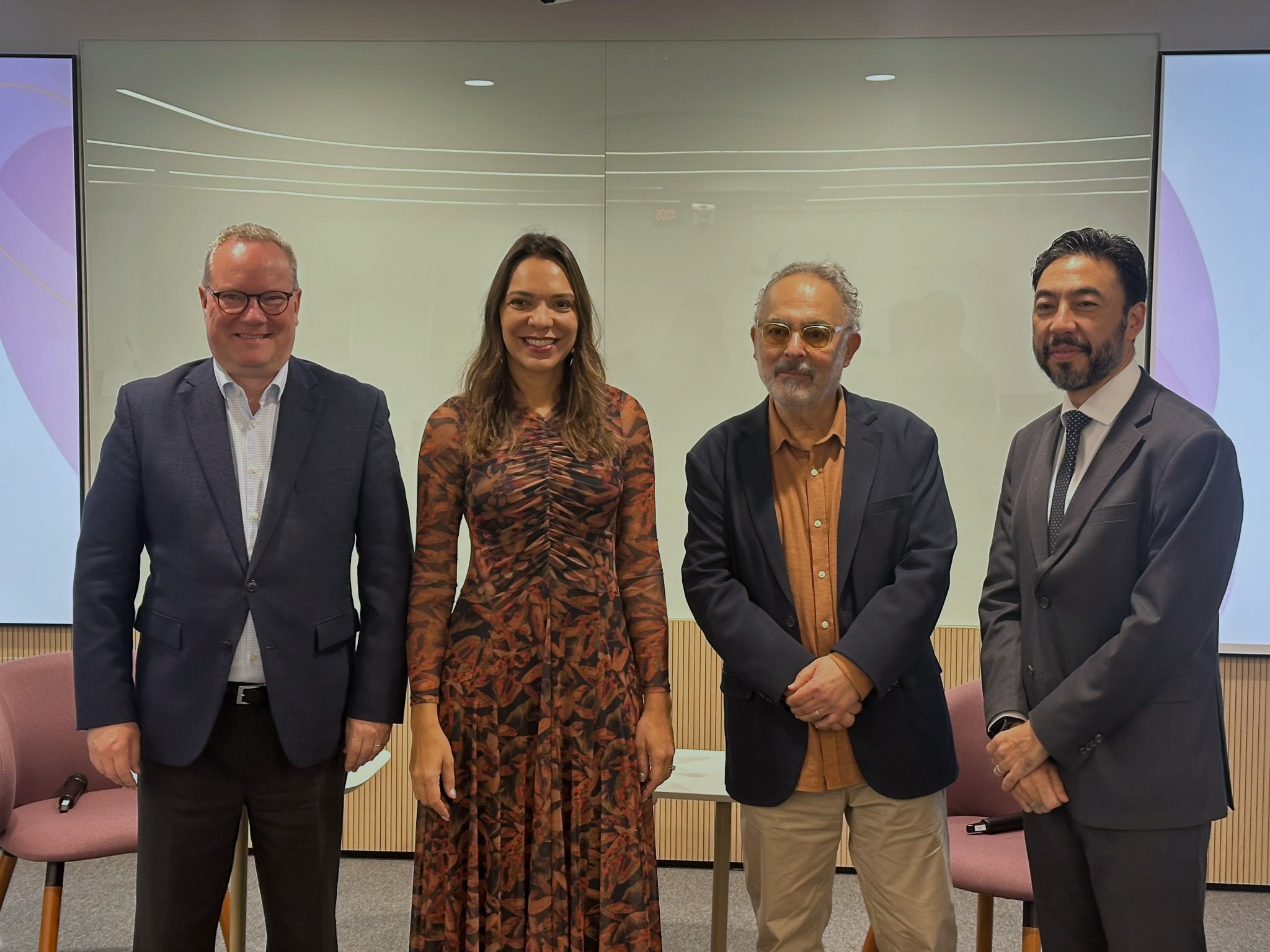
Dr. Hans-Dieter Holtzmann in Brazil, alongside speakers from the "AI, Fake News and Elections 2026" event.
Brazil is heading toward a new electoral cycle in a context radically different from that of previous elections. Artificial intelligence is no longer a technological promise or a tool reserved for specialists; it has become part of the everyday ecosystem of information production, circulation, and consumption. In a country of continental scale, with a highly connected and politically polarized society, this transformation raises the question of how to ensure that citizens can make free decisions when the public sphere is permeated by false, manipulated, or artificially generated content.
The Friedrich Naumann Foundation for Freedom organized the event “AI, Fake News, and the 2026 Elections” in São Paulo, in cooperation with the Dom Cabral Foundation and the Center for Public Leadership, as part of the International Journalist and Media Dialogue Program.
The event brought together journalists, communication experts, representatives of civil society organizations, and stakeholders involved in public debate to analyze the challenges that new technologies pose to the integrity of information, institutional trust, and the quality of democracy in Brazil. The panel featured Iuri Pitta, political editor at CNN Brasil; Cristina Tardáguila, founder of Agência Lupa; Paulo Nassar, CEO of Aberje; and was moderated by Patrícia Marins, visiting professor at FDC and founder of Oficina Consultoria.
Artificial intelligence offers enormous opportunities to expand access to information, improve public communication, and facilitate verification processes. But it can also be used to produce fake images, audio, videos and speeches with a level of realism that was previously unimaginable. During election seasons this capability takes on particular significance. It is not merely a matter of detecting fake news, but of navigating an information-saturated environment where it is increasingly difficult to distinguish facts from opinions, reliable sources from manipulation, and authentic content from artificially generated material.

From a liberal perspective, the response to this phenomenon cannot be censorship or the concentration of power. Freedom of expression is an essential condition of any open society. However, defending it involves creating the conditions so that every person can truly exercise their autonomy. A free citizenry needs reliable information, media literacy, institutional transparency, and tools to critically evaluate what they consume and share.
It is essential to protect freedom of expression while simultaneously promoting platform accountability, professional journalism, digital literacy and transparency. Disinformation erodes trust in the media, in institutions, in electoral authorities, and among citizens themselves. And without trust, democracy is weakened.
The case of Brazil is particularly relevant for South America. Brazil is not only the region’s largest democracy but also a political and communications laboratory where high levels of digital engagement, strong citizen mobilization, intense electoral competition and a public discourse marked by ideological tensions converge. In this context, disinformation operates not merely as a collection of false content, but as a deeper phenomenon affecting how people perceive reality, evaluate institutions, and relate to those who think differently.
During the debate, the experts agreed that artificial intelligence can be part of both the problem and the solution. Cristina Tardáguila presented initiatives that use AI to accelerate real-time verification processes, while Paulo Nassar drew attention to the transformation of trust relationships in a society mediated by digital platforms. The discussion allowed participants to go beyond the technological dimension. The problem is not merely which tools exist, but what democratic culture, what professional standards, and what shared responsibilities are built around them.
The 2026 elections will therefore be a test for both institutions and citizens. The integrity of the electoral process will depend not only on regulations, courts, or platforms, but also on society’s ability to sustain a public debate grounded in facts, arguments, and pluralism. Professional journalism, fact-checking organizations, universities, the private sector, civil society, and citizens themselves all have a role to play. No single actor can single-handedly resolve a challenge that affects the entire democratic ecosystem.

Offices of the Fundação Dom Cabral in São Paulo
Liberal tradition offers a particularly relevant response for this moment: trusting in people’s capacity, while taking seriously the conditions that make that freedom possible. This is not about replacing citizens’ judgment with authorities who decide what is true, but rather about strengthening education, transparency, and accountability so that freedom is not hijacked by manipulation.
Brazil has the opportunity to use technological innovation to expand citizen participation, improve public information, and strengthen accountability. The warning is that, without trust, even the most solid institutions can be weakened by constant suspicion and the fragmentation of the public sphere. Therefore, the challenge is not only technological or electoral but also democratic.
In a free society, the response to disinformation cannot be less freedom. It must be more civic engagement, more critical thinking, more professional journalism, more transparency, and better institutions.