Democracy
On the Riparian: Learning Deliberation from a Neglected Space

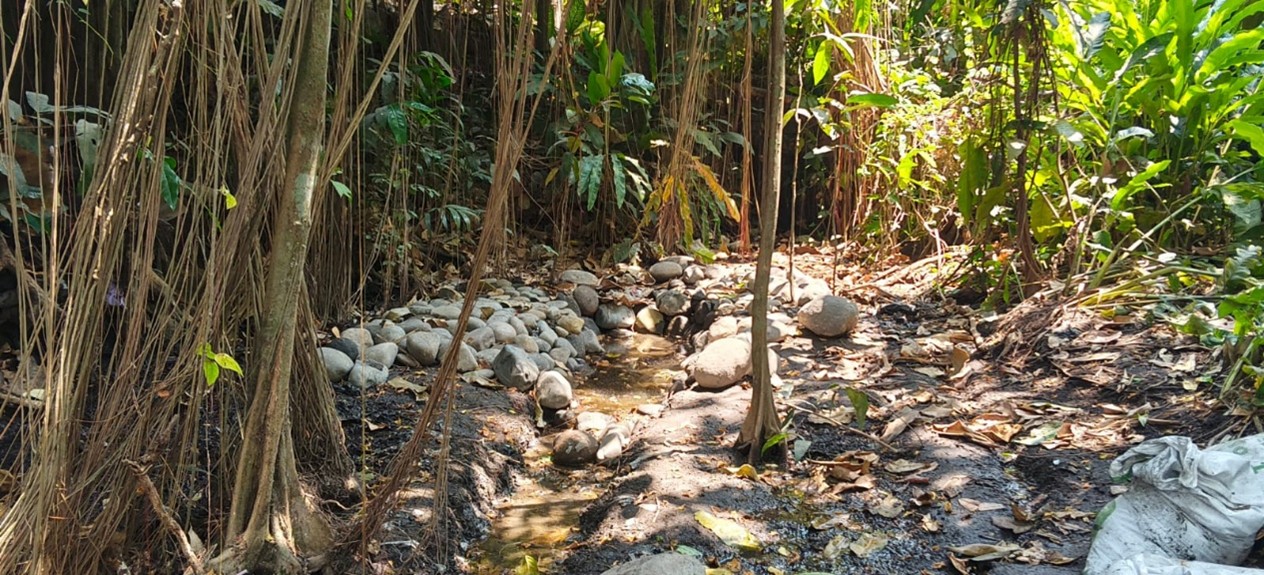
A photograph of the restored belik (small spring) in Grojogan, Author, 2026,
A Morning by the Riverbank
I had never expected a piece of privately owned land beside a river to become the centre of so much attention. For years, the site had attracted little interest beyond its immediate surroundings. Vegetation had grown freely over parts of it, waste had settled into the soil, and the sharp smell of swamp water mixed with rubbish lingered in the air. Taken together, these conditions made neglect the most fitting word to describe the landscape.
That changed, at least temporarily, when a belik—a small natural spring, often found near rivers and traditionally used by local communities—became the focus of a restoration activity. The activity took place in Grojogan, a local community in the Yogyakarta area, a region in Indonesia known for its strong neighbourhood networks and traditions of communal participation. That morning, a woro-woro, or public announcement made through the mosque loudspeaker, called young residents of Grojogan, particularly members of the karang taruna, Indonesia’s village- and neighbourhood-based youth organisation, to gather at the riverbank. Information about the activity had already circulated through the neighbourhood WhatsApp group during the previous week.
The planned attendance of GKR Hayu, Chair of the Provincial Karang Taruna, gave the morning a ceremonial quality that would have been unusual for an otherwise modest village activity. GKR Hayu is a member of Yogyakarta’s royal family and the fourth daughter of Sri Sultan Hamengku Buwono X, the hereditary ruler and governor of the Special Region of Yogyakarta, and GKR Hemas. Her presence connected the local activity to the wider civic and cultural significance of Yogyakarta, while the work itself remained grounded in the everyday life of the neighbourhood.
The usual quietness of the riverbank disappeared. Work concentrated around the belik, where the surrounding ground was cleared and river stones were used to strengthen the spring. Some residents and NGO members helped directly, while others remained nearby and followed what was happening. The result was hardly spectacular. The area looked cleaner, although waste remained embedded in parts of the soil, and nothing had changed in the legal status of the land.
Conversation unfolded alongside the work, rarely staying with one subject for long. A comment about waste could bring back a memory of what the riverbank had once looked like, only for the discussion to drift elsewhere before returning to what might be done with the area. Jokes and casual small talk filled much of the morning. I did not initially attach much significance to any of it, because this kind of conversation accompanies many collective activities in Grojogan.
What made me return to the morning came afterward. A local official who knew about my involvement with the NGO contacted me and raised the possibility of seeking donor support for other neglected spaces. Perhaps another site could provide somewhere for children to spend time, or perhaps a small area could eventually support community activities. No proposal existed yet. What had changed was more basic: the activity had produced a point of reference from which another neglected place could now be considered.
Digging into the “Political”
At first, I did not think of the activity in Grojogan as deliberation. As the morning began, people were simply cleaning a neglected riverbank. Looking back, however, I began to see its political dimension emerging in a quieter form. It appeared in the question of how a neglected place could become imaginable as something more than private land, and how different people could attach expectations to it without sharing the same authority over its future. The riverbank was no longer seen only as an abandoned edge of the village. It had become connected to questions of care and responsibility.
John Dewey’s understanding of democracy helps explain this process. In Democracy and Education, he describes democracy as “a mode of associated living, of conjoint communicated experience.” From my perspective, this points to the importance of shared experience in creating connections among people whose lives might otherwise remain separate. In The Public and Its Problems, Dewey also argues that a public emerges when people become connected through consequences that affect them, even when they do not initially share the same identity or purpose.
This is where deliberative democracy becomes relevant, although not as a ready-made model imposed on the Grojogan case. In Between Facts and Norms, Jürgen Habermas reminds us that democratic legitimacy depends not only on formal procedures, but also on communicative processes through which people form opinions and wills in relation to matters of common concern. John Dryzek’s work in Deliberative Democracy and Beyond extends this understanding by showing that deliberation should not be reduced to formal debate. Democratic communication may also involve different voices, forms of expression, and ways of making an issue publicly meaningful.
The riverbank became a point where such possibilities could be sensed. For residents, it represented a possible communal space. For local officials, it could be linked to their mandate. For the NGO, it offered the possibility of a programme. These perspectives did not merge into one unified vision. Instead, they created a situation in which the future of the site could no longer be understood from only one position.
This is also what made the activity significant. The gathering created a sense of possibility, yet those who participated in cleaning the riverbank did not automatically gain the right to determine its future. The riverbank became political because it brought different expectations into relation with one another. It showed that collective meaning can develop before collective authority exists, and that cooperation may create new possibilities without dissolving the multiple interests that emerge from them.
Learning from the Riparian?
The lesson I take from the activity is that the conversation did not fully disappear when the work ended. A cleaned spring is one thing; a question that begins to move from that spring toward other neglected spaces is another. Between the two lies a small but important shift. The activity no longer functioned only as work carried out at a particular site. It had become a reference through which other neglected spaces could be approached, discussed, and possibly shared in a more deliberative way.
This is the point at which the lesson of deliberation becomes clearer. From my viewpoint, deliberation requires more than people debating near one another. It requires a matter that can carry reasons and justifications, as well as some expectation that what is said may affect what follows. Around the riverbank, that matter was still being formed. Its shape remained uncertain, its continuation depended on people and institutions that did not occupy equal positions, and the interests surrounding it remained particular rather than fully shared.
The lesson from the riparian is therefore not that democracy surfaced in a clear or declarative form. What the morning suggested is that public reasoning often begins before people recognise a situation as political. The restoration of the belik mattered to me because it showed how a deliberative way of discussing what is important to people may emerge from a situation that was not initially expected to carry political significance.
A modest environmental activity became meaningful not because it produced a formal decision, but because it allowed a neglected place to become a reference for thinking about other spaces, other needs, and other possible forms of shared care.
*Muhammad Gufron Rum is the Executive Director of Yayasan Bentala Indra Nusantara (BINA Foundation) in Jakarta, Indonesia.