LI CONFERENCE
Liberalism Looks to Asia and Supports Taiwan
“Taiwan can contribute more, and Asia can contribute more.”
Legislator Fan Yan from Democratic Progressive Party of Taiwan (DPP) made that declaration during her election speech in Bangkok, as she competed for the vice-presidency of Liberal International (LI). Her words resonated the congress’s stance to look beyond its traditional strongholds and draw more actively on the experiences and contributions of Asia. “Together, we stand for freedom.”
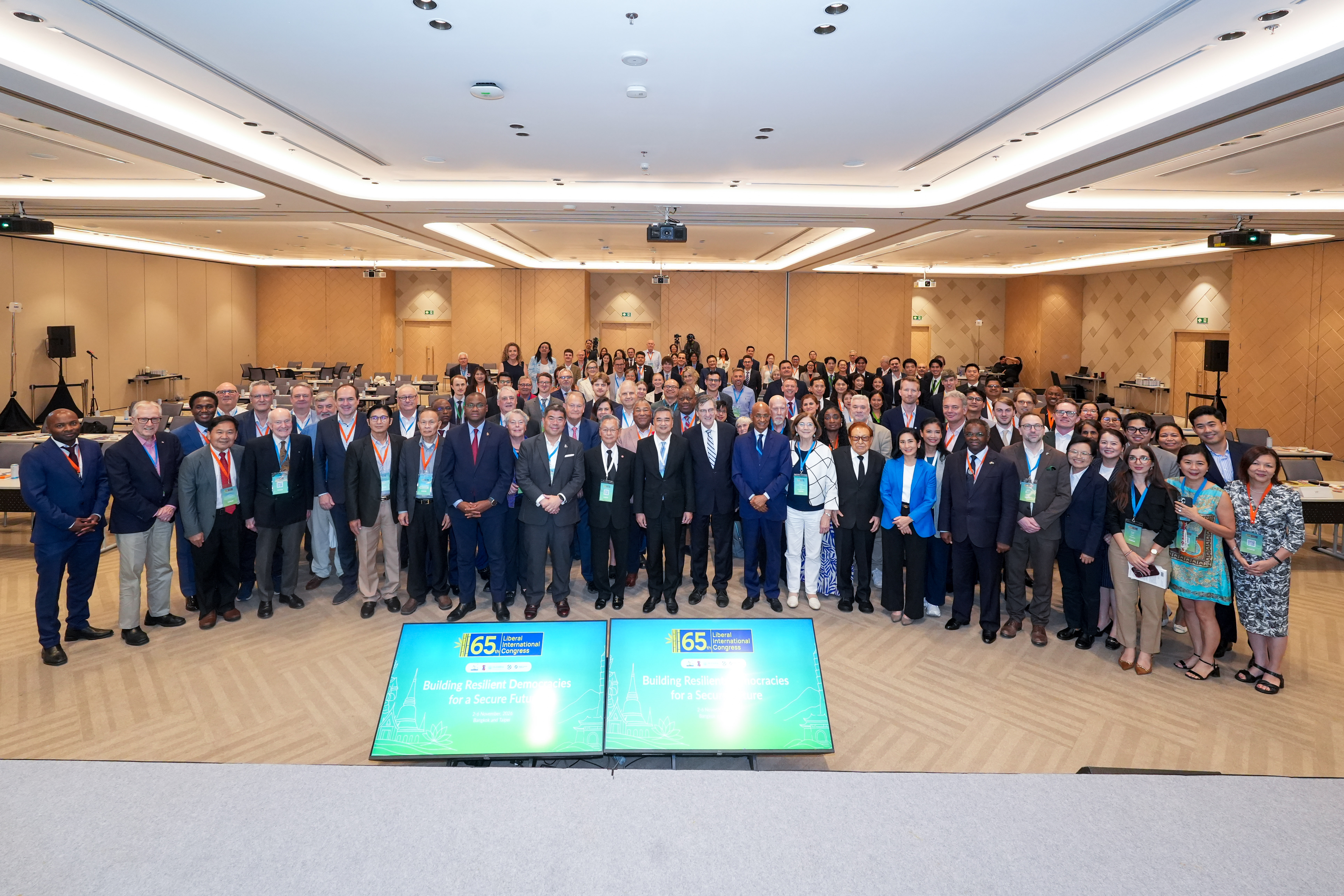
It was a particularly symbolic moment. After 15 years, Liberal International returned to Asia, making the unusual decision to convene its congress across two places: Thailand and Taiwan. The arrangement brought together liberal politicians, parliamentarians and party representatives from across the world, offering a platform for political exchange at a time of growing geopolitical tensions and democratic uncertainty.
The first leg of the congress took place in Bangkok, hosted by the Friedrich Naumann Foundation for Freedom and the Democrat Party of Thailand (DP). It was officially opened by Abhisit Vejjajiva, leader of the Democrat Party and former Prime Minister of Thailand, alongside representatives of the international liberal movement. The second leg moved to Taipei, hosted by Taiwan's Democratic Progressive Party (DPP), with the support from the foundation's Taiwan and Asia Offices.
For the DPP, the gathering carried an additional memory. The party was celebrating its 40th anniversary, coinciding with the congress and the confirmation of Fan Yan's election as Liberal International's vice-president. The Taipei programme also offered delegates an opportunity to engage with Taiwan's political leadership, including President Lai Ching-te, Vice President Hsiao Bi-khim, former LI’s vice-president, National Security Council Secretary-General Jaushieh Wu, and representatives of Taiwan's National Security Council and Ministry of Foreign Affairs.
For Fan Yan and the DPP, it was both a political achievement and an opportunity to reinforce Taiwan's place within the international liberal community.
A movement confronting its democratic recession
Held under the theme Building Resilient Democracies for a Secure Future, the 65th Congress unfolded against an increasingly difficult political landscape for liberals. Democratic decline, the growing influence of authoritarian leaders and escalating geopolitical tensions featured prominently in discussions. Participants also expressed concern about the weakening of the international liberal order, including the increasingly uncertain commitment of some traditional leaders of the free world to the institutions and principles that have underpinned it.
The challenge, however, extends beyond the rise of authoritarianism. Liberal democracy itself is experiencing a period of recession, with democratic institutions and political freedoms under pressure in countries across different regions. The congress therefore confronted a difficult question: how can liberals regain political relevance when the principles they defend are increasingly challenged, even in established democracies?
One recurring message was that defending liberal values requires more than repeating the language of freedom, democracy and individual rights. Liberals must demonstrate how these principles translate into tangible improvements in people's everyday lives. As President of Liberal Internal Karl-Heinz Paqué reminded delegates in his final speech in Taipei that liberal principles and institutions must be transformed into bread-and-butter issues for ordinary people if those values are to remain alive and politically meaningful.
Freedom, in this sense, is not merely an abstract political ideal. It creates the conditions for opportunity, which can, in turn, generate prosperity, leader of the Democrat Party in Thailand Vejjajiva noted. The task for liberals is to connect that promise to the concerns and aspirations of the people they seek to represent. In the end, “democracy itself is not rice.”

Winning elections without losing liberal values
The question of political relevance inevitably led to another issue: electoral success. “Liberals must regain their rightful place in politics,” Abhisit told the congress in Bangkok, emphasizing that winning matters. Without electoral victories, liberal parties risk losing their ability to shape policies, defend democratic institutions and keep the liberal order in place.
But winning alone cannot be the measure of success. At a panel examining the 2026 election landscape, Eva Kjer Hansen of Denmark's ALDE Party warned that liberals must remain united in defending their values. Political victories achieved by abandoning fundamental principles, she suggested, are not necessarily ethical or rightful victories.
The tension between electoral pragmatism and ideological consistency remains one of the movement's most difficult dilemmas. In an increasingly competitive political environment, some politicians may be tempted to trade their principles for political office. Yet, if liberal parties win elections at the expense of the values that define them, “what exactly have they won,” ALDE Party member Hansen questioned.
The congress therefore highlighted the importance of learning from successful liberal parties without losing sight of the principles that unite them, particularly at the panel organized by FNF Europe. Randy van Essen, Director of Campaigns and Communications from D66 Party, shared lessons from their electoral victory in the Netherlands, examining the strategies and political positioning that helped them succeed. Meanwhile, Taiwan's DPP member, Formosa Lee, presented his experience in contextualizing local preferences and connecting its political agenda with leadership personality. DPP also led the LI delegation to its current mayor candidate Puma’s office to showcase innovative and vibrant approaches to engage people of Taipei while mobilizing for votes.
These exchanges demonstrated that there is no single formula for winning elections. Political strategies must respond to local contexts, voter expectations and the realities of individual political systems creatively and responsibly.
Beyond elections: Rebuilding the liberal agenda
The discussions extended beyond electoral politics. Trade, women's justice, artificial intelligence, transnational repression and youth participation in politics were among the issues shaping conversations throughout the congress.
These topics reflect the increasingly complex environment in which liberal parties must operate. Technological transformation is changing societies and political communication. Geopolitical rivalries are reshaping international cooperation and trade. Meanwhile, restrictions on civil liberties and transnational repression raise new questions about how democratic governments can protect freedom beyond their own borders.
Youth participation was another important part of the broader discussion. For a movement concerned about its future, engaging younger generations is not simply a matter of representation. It is about ensuring that liberal ideas remain relevant to people who will shape the political landscape and push forward these principles in the decades ahead.
The congress also reinforced the importance of international solidarity. Liberal parties cannot confront democratic challenges in isolation. They need stronger networks, shared political experiences and a willingness to support one another when democratic institutions and freedoms come under pressure.
Asia's growing place in global liberalism
The decision to hold the 65th Congress in Bangkok and Taipei was more than a logistical arrangement. It offered a reminder that liberalism is a global political movement whose future cannot be determined by Europe or North America alone.
Fan Yan's election speech in Bangkok captured this aspiration. Her call for greater contributions from Taiwan and Asia reflected a broader ambition to give the region a stronger voice in shaping the international liberal agenda. Taiwan, in particular, offered a significant setting for these discussions. Its experience of democratic development, its geopolitical position and its engagement with the international democratic community provided delegates with a perspective on the challenges of defending freedom and democratic resilience in an increasingly contested region.
The congress concluded in Taipei on November 6, bringing several days of discussions, political exchanges and renewed commitments to a close. With the next congress expected to take place in Africa, Liberal International is looking towards another region where the movement can deepen its engagement and broaden its global representation.
The 65th Congress did not offer an easy answer to the challenges confronting liberal democracy. Nor could a few days of meetings resolve the divisions, electoral setbacks and geopolitical pressures facing liberal parties worldwide. But it did underline a fundamental lesson: liberalism cannot survive on principles alone. It must translate those principles into political choices, policies and opportunities that people can see and experience in their everyday lives.
For a movement seeking to regain its rightful place in politics, the challenge is not simply to win more elections. It is to win without losing its values and to build a global liberal community in which Asia, Africa and other regions have an increasingly meaningful voice. The Friedrich Naumann Foundation is proud to support this inclusive and meaningful journey of liberal movement.
*Hnin Wint Naing is the regional communication officer of the Asia Office of the Friedrich Naumann Foundation for Freedom.
Congress Gallery (Swipe for more photos)


