AI chatbot
Who Runs Your Chatbot?

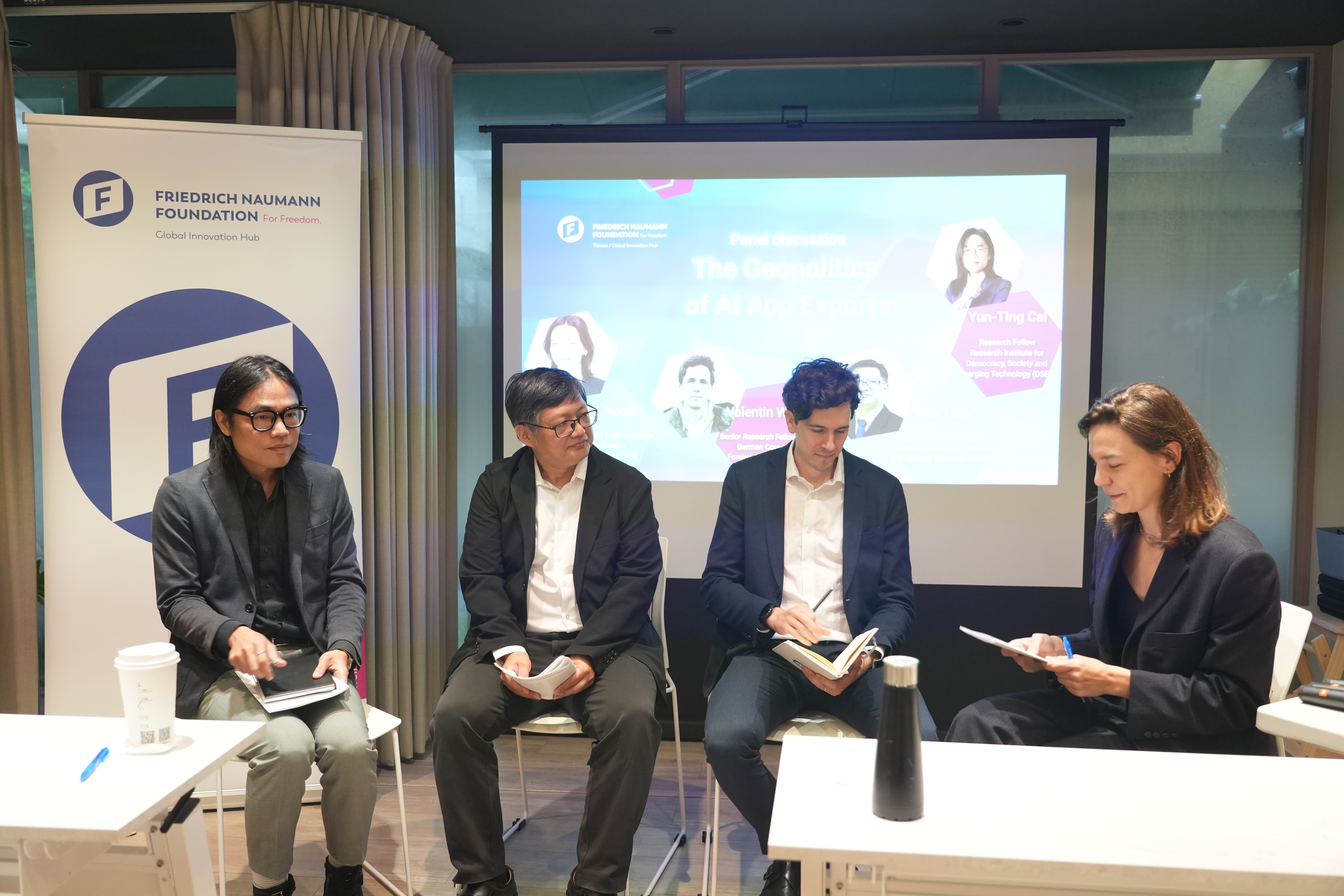
Panel discussion at launch event of "The Geopolitics of AI App Exports".
Whoever runs the chatbot shapes what users see, trust and act on. That was the starting point when the FNF Global Innovation Hub launched Dr. Valentin Weber's policy paper "The Geopolitics of AI App Exports" in Taipei on 4 September 2026.
The paper shows U.S. apps leading worldwide and Chinese apps steadily closing in, especially in some Latin American and Southeast Asian countries.
Two factors help explain the rise of Chinese AI chat apps. They are inexpensive to use, and they benefit from strong distribution channels. Dola’s parent company, for example, uses its own social media platforms to promote the chatbot.
Influence You Cannot See
However, the most downloaded apps are only the visible layer. Experts pointed to a quieter channel: apps that run on Chinese models without saying so. One example was Nur AI, a niche chatbot that offers Sharia-aligned answers but runs on DeepSeek and gives strongly pro-Beijing responses when asked about China.
More broadly, ownership, data flows and model origins are often opaque, and Chinese apps' terms of service may let user data flow back to China. The experts' advice for governments, businesses and users alike: read the terms, verify first, then trust.

Dr. Valentin Weber presenting his new policy paper "The Geopolitics of AI App Exports".
Choosing the Best, Guarding the Rest
Taiwan sits firmly in the U.S. sphere. Experts described the paper's figure for Taiwan, 93% of chatbot downloads going to U.S. apps and 7% to Chinese ones, as "very accurate." Government restrictions on Chinese models over data-security risks play a part. So does a simple preference: users want the best tools, and in coding and drafting they still see a clear gap.
That gap is no accident. Leading Chinese models such as DeepSeek, Moonshot and MiniMax, experts noted, are largely distilled from U.S. frontier models, so China's progress still depends on access to American systems.
Taiwan's rules remain targeted rather than sweeping. Chinese apps are barred on office devices and during working hours, while private use stays a personal choice, a balance experts described as the way a democracy regulates technology.
Distillation: A Risk and an Opportunity
Distillation, training a model on another model's answers, cannot be fully stopped, experts agreed. Know-your-customer checks on API access and export-style controls on remote access can slow it, while query limits remain a proposal. Watermarking was seen as weak, since the marks fade over time.
Yet the technique itself is neutral. Used within the terms of service, it lets middle powers such as Taiwan build smaller, specialised models of their own, a practical path to more AI sovereignty without matching the frontier labs.
The Next Dependency Is Physical
Chatbots may not be the hardest challenge to manage. Experts warned that physical AI, from robots to autonomous vehicles, will bind countries more tightly: China dominates an estimated 98% of the humanoid-robot supply chain, and replacing hardware takes years, not an app update. Europe, they argued, should act before that dependency sets in rather than try to de-risk afterwards.