Iceland’s EU Referendum
A Saga of Fish, Europe and Power

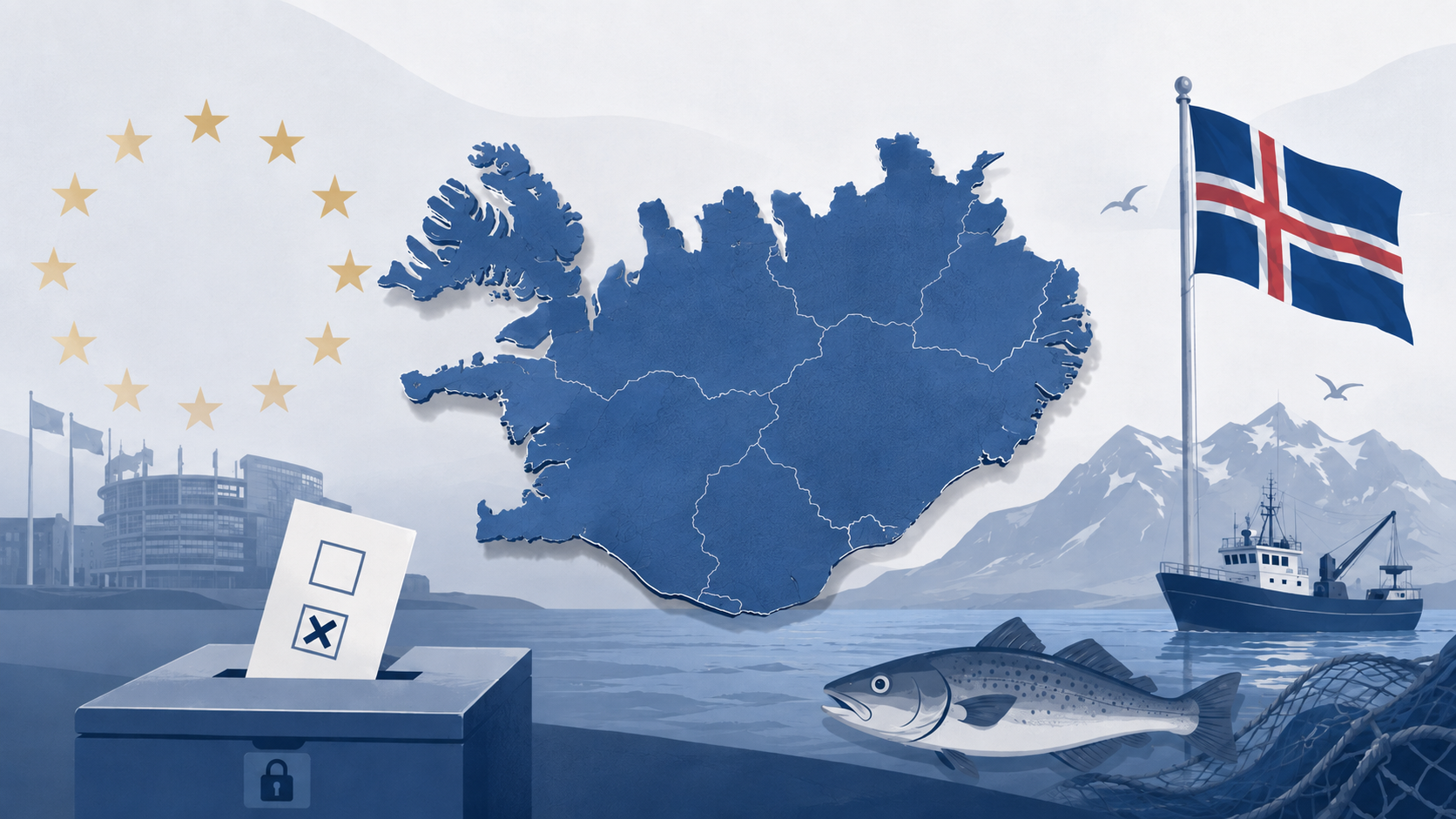
On 29 August, Icelanders narrowly rejected the proposal to reopen negotiations on EU membership. 52.8% voted against and 47.2% in favour, with turnout reaching 82.5%. The result exposed a striking geographical divide: Reykjavík voted Yes, while every other constituency voted No. Reykjavík North returned 57.5% for reopening talks and Reykjavík South 54.5%, while the Northwest voted 62.9% against and the Northeast 61.2% against.
The result was more than a rejection of EU negotiations. It was a victory for the forces defending Iceland’s existing model of European integration without membership, and, above all, for the powerful interests built around the country’s fishing industry.
The referendum did not ask Icelanders whether they wanted to join the EU. It asked whether negotiations should resume. Even a Yes vote would only have reopened the process; any eventual accession treaty would have required another referendum. Yet opponents successfully turned the vote into a choice between Icelandic sovereignty and Brussels.
From financial crisis to European integration From financial crisis to European integration
Iceland’s relationship with the EU has always been complicated. The country is deeply integrated into Europe without being an EU member. Since 1994, Iceland has participated in the European Economic Area (EEA), giving it access to the EU Single Market and the free movement of goods, services, capital and people. Iceland is also part of the Schengen Area.
The question of full membership gained new momentum after the 2008 financial crisis. Iceland’s banking system collapsed, the króna lost much of its value and the country imposed capital controls. The crisis also revived the debate over Iceland’s small and volatile currency and whether closer European integration could provide greater economic stability.
In 2009, the government led by the Social Democratic Alliance and Left-Green Movement formally applied for EU membership. Accession negotiations opened in 2010 and progressed relatively quickly, with 27 of 35 negotiating chapters opened and 11 provisionally closed. However, fisheries remained a major obstacle. Iceland sought to retain control over its waters and fishing resources, while EU membership would bring the country under the Common Fisheries Policy.
Following a change of government in 2013, the negotiations were suspended. Two years later, Iceland formally asked the EU not to regard its membership application as active.
The issue never disappeared. It simply went dormant.
EU membership returned to the political agenda after the 2024 parliamentary election, which produced a three-party coalition of the Social Democratic Alliance, the liberal Reform Party (Viðreisn) and the People’s Party. Their coalition agreement committed the government to holding a referendum on whether Iceland should resume accession negotiations.
The initiative was particularly strongly supported by the pro-European Viðreisn, led by Foreign Minister Þorgerður Katrín Gunnarsdóttir. The Social Democrats also supported reopening negotiations, while the People’s Party remained opposed to EU membership.
The “Yes” campaign: a seat at the table
The “Yes” campaign argued that Iceland already enjoys many of the benefits of European integration through the EEA, but has little influence over the decisions behind the rules it implements.
The central pro-EU argument was therefore straightforward: Iceland already follows many European rules, so why not have a seat at the table where those rules are made?
Supporters also pointed to economic and geopolitical considerations. EU membership could eventually provide access to the euro, potentially reducing the problems associated with Iceland’s volatile currency and high interest rates. Iceland’s position in the North Atlantic and Arctic also made the security argument increasingly important, particularly amid Russia’s war against Ukraine, growing geopolitical competition in the Arctic and uncertainty surrounding the United States.
For a country of fewer than 400,000 people, supporters argued, EU membership could also give Iceland greater collective weight on trade, energy, climate and Arctic policy.
Fishing was the red line
For decades, Icelandic sovereignty has been closely associated with control over its fishing grounds. The fishing industry therefore presented EU membership not simply as an economic question but as a question of national sovereignty.
The concern was straightforward: joining the EU would bring Iceland into the Common Fisheries Policy and potentially expose its waters, fishing companies and quota system to European rules and competition. Fisheries account for roughly 40% of Iceland’s export revenues, making the sector disproportionately important to the national economy.
This gave the No campaign a remarkably effective message. Why surrender control over an industry Iceland already manages successfully in exchange for benefits it already receives through the EEA? The argument was particularly powerful outside Reykjavík, where fishing and related industries are deeply embedded in local economies and communities. The referendum map followed this geography almost perfectly- Reykjavík voted Yes; rural and coastal Iceland voted No.
The “fisheries mafia” and the concentration of power
Iceland’s fishing industry is not simply a large economic sector. It is highly concentrated. According to research cited in the Icelandic debate, the companies controlling the largest fishing quotas have accumulated enormous economic power. A recent investigation by Follow the Money found that the 20 companies with the largest quotas had invested around €1.2 billion in Icelandic fisheries in 2024. University of Iceland economist Þórólfur Geir Matthíasson has also pointed to the ability of the same interests to exercise influence across sectors including fishing, retail and fuel distribution.
This has led critics to describe the sector as a “fisheries mafia” or a modern oligarchy. The terminology is deliberately provocative, but the underlying democratic question is serious. The issue is not simply whether Iceland should control its fishing resources nationally. It is who controls those resources inside Iceland.
National ownership and democratic control are not the same thing. If a relatively small number of companies and families control a large share of a country’s most valuable natural resource, their ability to shape politics can become disproportionate. A country can retain formal sovereignty over its resources while allowing effective control to become concentrated in a narrow private economic elite.
The existing concentration of economic power gave the industry significant political reach. Reform Party’s Finance Minister Daði Már Kristófersson, quoted by Berlingske, has acknowledged that governments have tried for years to address the concentration of power in the fisheries sector, but that reforms have repeatedly been blocked by “strong interest groups” with influence in parliament. The Independence Party has traditionally been closely associated with the interests of business and the fishing industry, while the Progressive Party has historically represented rural and agricultural constituencies. Newly created parties, like the Reform Party, point at pathologies and try to challenge the status quo.
The result of this clash was that an issue which could have been discussed as a technical question of fisheries management became a much broader question of identity, sovereignty and national self-determination.
Brussels offered flexibility — but not a blank cheque
The European Commission understood that fisheries would be decisive. European officials emphasised Iceland’s “unique specificities” and suggested that creative solutions could be found. Enlargement Commissioner Marta Kos said Iceland’s “particular characteristics” in fisheries and agriculture would have to be carefully considered and expressed confidence that “creative solutions” could be found. EU Fisheries Commissioner Costas Kadis also noted before the referendum that an accession treaty can contain certain derogations from EU rules.
But this was not a promise of a permanent Icelandic exemption from the Common Fisheries Policy. The Commission stressed that concrete arrangements could not be discussed before negotiations had even restarted. For Reykjavík, the possibility of negotiating special arrangements could make EU membership conceivable. For the fishing industry, however, entering negotiations already meant opening the door to uncertainty over a system that had generated enormous economic value. And that uncertainty was enough.
The result was a cold shower for the Icelandic government and a setback for Brussels, which had hoped that Iceland could become the EU’s next member and demonstrate that the Union remained attractive to wealthy, stable European democracies.
For the Icelandic government, the result closes the issue for the foreseeable future. Prime Minister Kristrún Frostadóttir had said before the vote that a “No” would take EU membership off the political agenda during the current government’s mandate. It’s very difficult for the Reform Party, associated with the pro-European agenda. In the first poll after the referendum the liberals lost almost 2% points, and will have to find a new narrative to convince the voters they are still needed.
The government has accepted the result and is now expected to focus on preserving social cohesion after a highly emotional campaign. President Halla Tómasdóttir deliberately remained above the partisan debate. After the vote, she stressed the need to move beyond the referendum and preserve democratic dialogue: “We may hold different views, but we share far more than what divides us.”
For Brussels, the defeat is more than a narrow referendum loss. Iceland was already deeply integrated with the EU through the EEA and Schengen, meaning that accession would have represented a relatively easy enlargement compared with many other candidate countries. The result demonstrates the limits of the EU’s appeal in a country that already enjoys many of the economic benefits of integration without accepting full political membership.
Iceland and Europe’s Eurosceptic right
The referendum also revealed that Iceland’s debate was not completely isolated from the wider European battle over integration. An investigation by Follow the Money revealed that Icelandic companies funded Eurosceptic groups and think tanks in Brussels, e.g. ECR and its foundation; ADDE, IDDE. Jouralists also found financial and organisational links between Icelandic business interests involved in the anti-EU campaign and organisations associated with the British Brexit movement. Icelandic fishing interests had contributed money to British Eurosceptic organisations, while some campaign strategies resembled those developed during Brexit.
The parallel is politically significant. The core narrative was remarkably similar: Brussels threatens national sovereignty. National resources must remain under national control. International institutions are less democratic than domestic control. The country can trade with Europe without becoming part of the EU.
This does not mean that Iceland’s No campaign was simply a European far-right operation. Opposition to EU membership included mainstream conservatives, agrarians, fishing interests and people with long-standing nationalist concerns. But there was a clear convergence between sectoral economic interests and the broader European Eurosceptic narrative. After the result, European right-wing figures including Marine Le Pen and Nigel Farage celebrated Iceland’s rejection of renewed EU talks as a victory for national sovereignty.
The democratic paradox
This creates the most interesting lesson of the Icelandic referendum. The vote was unquestionably democratic. Turnout was record high, the question was clear and the government accepted the result. But democracy is not only about whether citizens can vote. It is also about who has the capacity to shape the choices put before them and the political narratives surrounding those choices.
Iceland, country with the oldest still working parliament in the world, has a particularly strong tradition of seeing democracy as something close to home, local, pragmatic and rooted in the idea that Icelanders should ultimately decide their own affairs. That tradition was visible in this referendum. Yet the Icelandic way also raises a difficult question. Does national control automatically mean democratic control? This is the key question Icelandic liberals will have to answer to build a new narrative that will replace the EU-membership goal that was their raison d’être until August 29.
About the author: Miłosz Hodun is President of Projekt: Polska, a member of the Board of Directors of the European Liberal Forum (ELF), and holds a Doctor of Philosophy degree from Reykjavík University.