India
Geopolitical dynamics favour India–EU trade deal

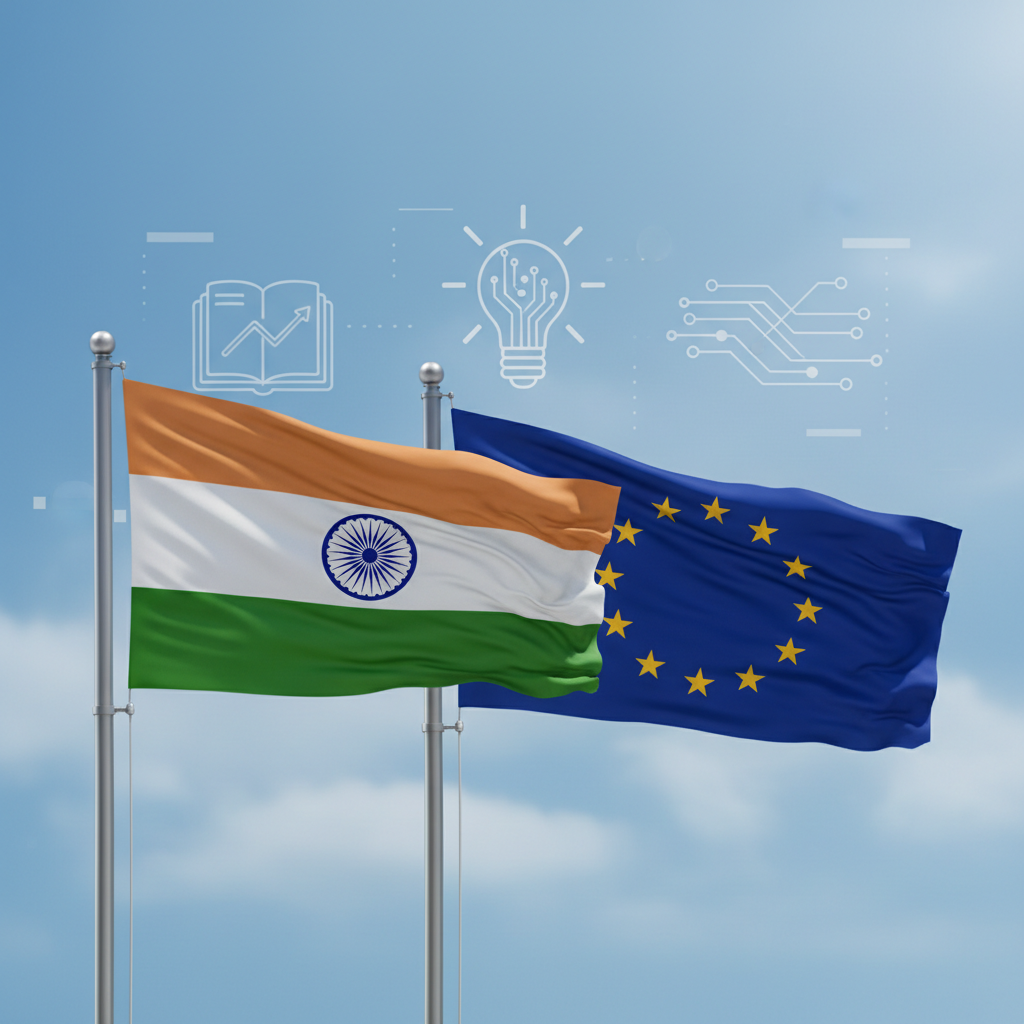
Indien und die EU
© Bild erstellt mit KIBeyond the economic rationale, the prevailing geopolitical context has compelled the EU and India to conclude the trade deal, even if it falls short of the depth and comprehensiveness originally envisaged by the EU. With the multilateral trading system under severe strain due to the Trump administration’s tariff and non-tariff measures, the agreement could serve as a strong signal of continued commitment by India and the EU to a rules-based trading order. For India, trade agreements with European partners are also a way to diversify part of its export dependence away from the US and towards alternative markets. Both also face their own set of challenges in dealing with a rising and increasingly assertive China. In this context, the agreement could also serve as a building block for broader economic partnerships in the Indo-Pacific.
The core is still economics
As economics remains at the core of the India–EU partnership, the trade deal will provide fresh momentum across a wide range of areas in which India conducts its business, both within the EU framework and with individual member states. In 2024, bilateral trade in goods and services exceeded $210 billion. Cumulative EU FDI inflows into India have crossed $160 billion, with around 6,000 EU companies operating in the country. Similarly, Indian companies are making significant investments and acquisitions in EU markets. With considerable untapped potential, the FTA could provide a new momentum to ties. Within Asia, however, economic linkages with China remained a major focus for many EU member states, including Germany. In 2024, EU–China trade in goods and services stood at around $980 billion, and roughly 12,000 EU-linked companies operated in China through manufacturing, investment, or commercial activities. As many European firms now seek to diversify away from China, India could offer a credible alternative.
Similarly, the EU has been, and will continue to be, a key partner in India’s ambitious journey towards a Viksit Bharat (developed India) by 2047, through trade, investment, and technology. At the same time, India’s large and growing economy, with several globally competitive sectors, remains highly attractive to Europe. Many issues in the India–EU FTA have been well known for years, including tariffs and non-tariff barriers on agricultural goods, wines, and automobiles, as well as broader market access concerns. India has also been advocating for greater mobility for skilled professionals. This issue is now being addressed more at the member-state level through migration and mobility agreements. The EU’s Carbon Border Adjustment Mechanism (CBAM) adds further complexity to the negotiations, while the EU is also pressing for TRIPS-plus provisions, stricter enforcement, data exclusivity, and enhanced patent protection. On CBAM, India would like the EU to recognise its “equivalent efforts,” even if achieved through different policy tools, in order to ease the CBAM burden. On sustainability and labour standards—a key EU demand—the EFTA agreement could serve as a model, as India accepted similar provisions there without binding commitments. Issues related to government procurement have been addressed in recent Indian agreements, such as with the UAE. For wines and agricultural products, India’s agreements with Australia, New Zealand, and the UAE could provide useful reference points.
Even a modest FTA could transform ties across multiple areas
India has been negotiating trade deal with the EU since 2007. After several missed deadlines and twelve rounds of formal negotiations, the talks were frozen in 2013 due to a “mismatch in the level of ambitions.” Meanwhile, New Delhi terminated its Bilateral Investment Treaties with a large number of countries, including 22 EU member states. As progress on trade and investment stalled, both sides began expanding cooperation into other areas. Today, the India–EU institutional architecture includes more than 40 dialogue mechanisms and working groups, covering a wide range of issues such as migration, cybersecurity, counter-terrorism, maritime security, human rights, agriculture, energy, urbanisation, water, and innovation.
In 2021, when India and the EU decided to restart three parallel negotiations on stand-alone agreements covering trade, investment protection, and geographical indications (GI), they also established a separate “connectivity partnership”. Meanwhile, they also launched the Trade and Technology Council (TTC) with three working groups: strategic technologies and digital governance, green and clean energy; and trade, investment, and resilient value chains. In February 2025, the visit of the European Commission President, accompanied by more than 20 Commissioners underscored the importance of this partnership. This despite the fact that Indian and European perceptions about the Ukraine war differs significantly.
In September 2025, the European Commission unveiled a new India strategy which outlines a new bilateral agenda built on five pillars: Prosperity and Sustainability (trade, investment, clean energy); Technology and Innovation (digitization, emerging tech, research); Security and Defence (security cooperation, defence industry); Connectivity and Global Issues (global governance, connectivity, third‑country cooperation); and People-to-People (mobility, skills, mutual understanding) to support the other four pillars.
The strategy outlines numerous bilateral initiatives to support the EU’s 2050 and India’s 2070 net-zero commitments, particularly in renewables and the circular economy. Cooperation is also expected in economic security, with a focus on critical minerals and the semiconductor sector. Collaboration on Digital Public Infrastructure projects, including their extension to third countries, is explicitly mentioned. To enhance Defence Industrial cooperation, an industry-led EU–India Defence Industry Forum is proposed. Connectivity initiatives are aligned with the EU’s Global Gateway and India’s MAHASAGAR initiative. The India–Middle East–Europe Economic Corridor (IMEC) is emerging as a flagship example of collaboration.
Domestic political economy constraints on both sides suggest that the final agreement may fall short of the comprehensiveness initially envisaged. India remains firm on protecting the interests of farmers and small and medium enterprises, though it may be willing to accommodate some non-trade issues. The EU may have to moderate its expectations on immediate market access.
However, the geopolitical timing is favourable, particularly in the context of disruptions caused by US tariffs. Recent developments indicate strong political commitment on both sides to conclude a deal in the coming weeks. Beyond its signalling value, the agreement could add substantive depth to the India–EU strategic partnership. While the FTA may not fully offset US trade disruptions or the EU’s de-risking strategy vis-à-vis China, it could still secure improved access to India’s rapidly growing market over the medium term.
*Prof Gulshan Sachdeva is Jean Monnet Chair and Professor at the Centre for European Studies, Jawaharlal Nehru University, New Delhi.