Populism
When anger shapes votes

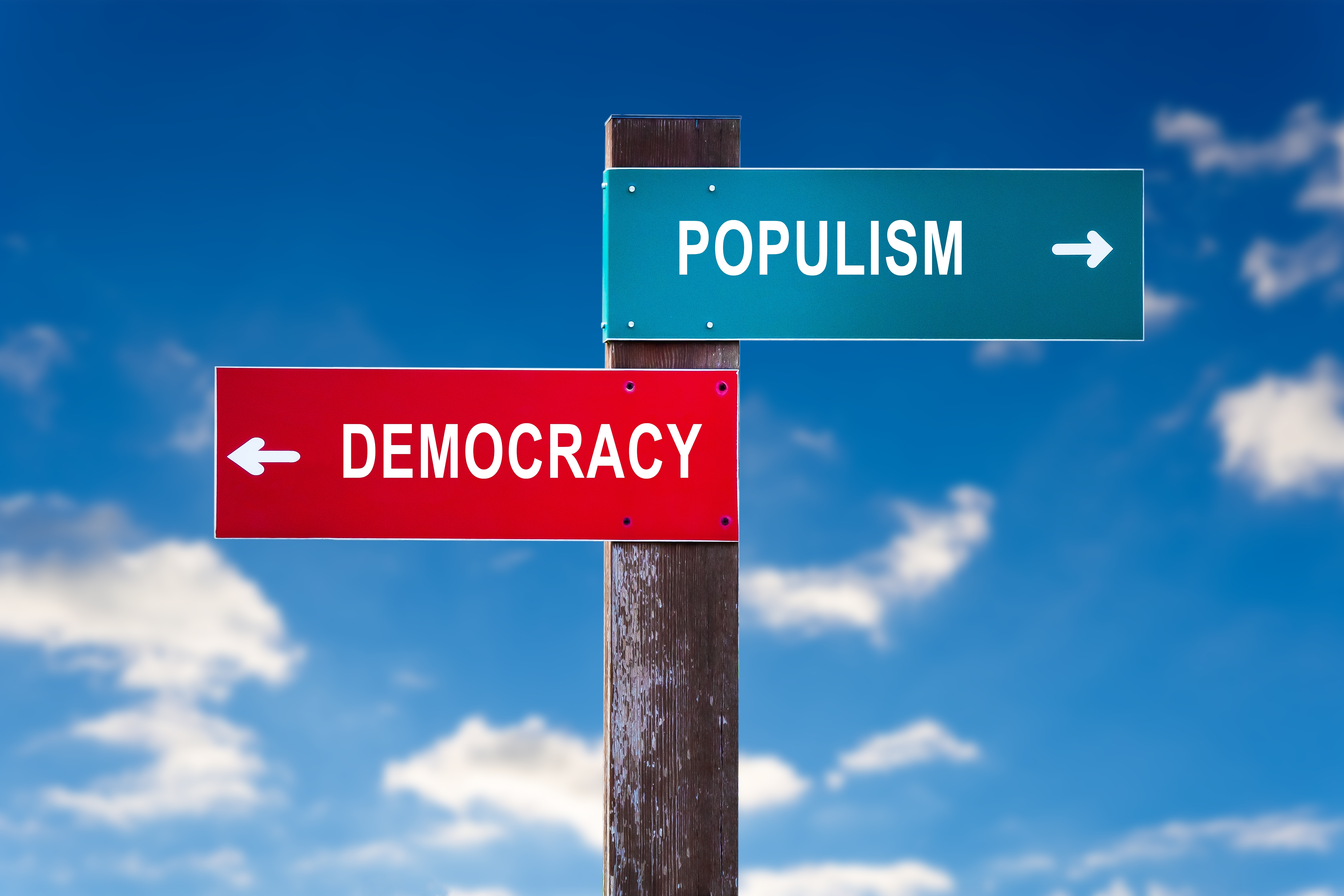
Populism versus Democracy - Road sign with two options
© ShutterstockThe 2024 and 2025 African elections revealed an intensifying wave of populism that is reshaping political landscapes from Southern to Eastern Africa.
As political parties capitalise on public frustration, democratic institutions are coming under growing pressure, with consequences that extend far beyond the continent. For Germany, which depends on stable democratic partners in the Global South, the rise of populism presents both strategic and economic concerns.
Across several African states, populist movements gained momentum by framing elections as battles between ordinary citizens and corrupt elites, often at the expense of institutional integrity. Tanzania and South Africa offered some of the clearest examples of this trend.
In Tanzania, both the ruling Chama Cha Mapinduzi and sections of the opposition relied heavily on populist rhetoric, drawing on public anger over rising living costs, corruption, and limited economic opportunities. The election period saw increasing pressure on journalists and civic organisations, pointing to a shrinking democratic space as polarising narratives replaced meaningful policy debate.
South Africa followed a similar pattern. The Economic Freedom Fighters intensified their radical economic messaging, while Jacob Zuma’s MK Party stepped up attacks on the courts, the Electoral Commission, and the media. These actions further weakened public trust in institutions that are central to democratic accountability.
The MK Party secured more than four million votes in the 2024 elections despite offering no clear policy platform. Its strong showing in KwaZulu Natal, Zuma’s home province, highlighted how powerfully populist messages resonate in communities frustrated by inequality, unemployment, and persistent governance failures.
According to Professor William Gumede, Executive Chairperson of the Democracy Works Foundation, Africa’s democratic and development challenges are deeply connected to populism.
He argues that countries in the developing world that have succeeded since the Second World War did so by avoiding populist approaches. Singapore, South Korea, and Japan, he notes, pursued evidence based policies that were often unpopular but effective, a path rarely followed in Africa.
Gumede believes the continent has experienced repeated waves of populism across generations. In his view, Africa’s failure to achieve sustained development since the nineteenth century is closely linked to these cycles. Breaking free from them, he says, will require leadership that prioritises practical policy over political theatrics.
He points to African examples where this shift has occurred. Mauritius, Cape Verde, and Botswana managed to move away from populist cycles and achieved long term economic stability. Replicating this success across the continent, however, will be extremely difficult.
Political analyst Sanusha Naidoo from the Institute for Global Dialogue highlights the structural conditions that allow populism to thrive. She explains that populism feeds on fear and anxiety and is shaped by how political systems respond to social change.
Naidoo argues that defining populism in the African context is itself a challenge. In many cases, what appears to be populism is a reaction to entrenched political systems that have failed to deliver services, accountability, and economic opportunity.
She points to Tanzania as an example where young people are increasingly rejecting old political narratives. Many, she says, are openly challenging leaders and signalling that they no longer accept being spoken for.
For countries like Germany, these developments carry real consequences. Stable, rules based governance in Africa is essential for secure supply chains, energy cooperation, and regional security partnerships. When populist politics weaken institutions, policy becomes unpredictable and long term cooperation more difficult.
Despite the challenges, the future is not fixed. Populism is a political choice, and voters can choose differently. By supporting evidence based policies, strengthening civic education, and backing leaders who focus on governance rather than spectacle, African societies can begin to reverse the trends seen in recent elections.