Southeast Asia
Future-Proofing ASEAN`s Investment Regulation


A new paper “Future-Proofing Investment Regulation Across ASEAN” - commissioned by the Asia Office of the Friedrich Naumann Foundation for Freedom - looks at Singapore, Vietnam, Indonesia and the Philippines from 2019 to 2025. The study traces how these four countries are trying to manage rising geopolitical and security pressures without abandoning openness or unsettling investor confidence.
The authors, Mohammad Jamil Hilmi bin A Ghani and Dr Stewart Nixon, point out that for ASEAN economies, foreign direct investment is more than a source of capital. It has long been tied to industrialization, job creation and export growth, the foundation of the region’s economic rise. Global shifts since 2019 have reshaped how governments weigh the benefits of investment against the risks that now come with it. Geopolitical tensions, technological rivalry, digital economy vulnerabilities and supply chain disruptions are forcing a recalibration: investment governance is increasingly moving beyond economics and into questions of security and resilience.
That shift is visible in how several ASEAN member states are rewriting the rules. The paper argues that “conditional openness” is emerging as a defining approach: keeping liberalization as a strategic priority, while embedding safeguards to manage national security, data governance and critical infrastructure risks. In a global investment environment marked by heightened uncertainty, this balancing act is becoming a crucial part of ASEAN’s attractiveness to foreign capital.
The paper identifies the different routes countries are taking to reach the same goal: staying competitive while protecting strategic interests. Singapore has adopted a highly targeted security screening regime centered on designated entities, supported by intervention powers that allow authorities to act when necessary. Vietnam is consolidating its longstanding approval-based investment model while introducing more structured mechanisms for security vetting. The Philippines is liberalizing long-protected public service sectors, while adding national security review provisions to prevent critical infrastructure from falling under risky ownership. Indonesia, meanwhile, is managing strategic exposure less through formal screening and more through industrial policy tools that shape the composition and direction of inbound investment.
The differences are striking, but the challenge is shared. In each case, the durability of investor confidence depends on predictability: clear thresholds, transparent procedures and consistent institutional practice. Safeguards that are vague or unevenly enforced can chill investment just as surely as outright restrictions. Strengthening governance capacity, particularly around screening processes, sectoral oversight and inter-agency coordination, is therefore essential if ASEAN governments want to tighten strategic controls without undermining the openness that has powered the region’s growth.
What emerges from these four case studies is not a retreat from global capital, but a more cautious form of engagement: one shaped by the realities of a more fragmented world economy. The question for ASEAN is no longer simply how to attract investment, but how to do so while managing the strategic risks that increasingly accompany it.
* Hnin Wint Naing is the Regional Communications Officer at the Asia Office of the Friedrich Naumann Foundation for Freedom.
Read more about the experience of these four ASEAN economies, and how they are working to protect national interests while maintaining continued openness by downloading the paper here.
-
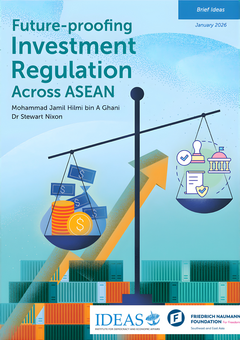
Foreign direct investment (FDI) remains central to ASEAN’s growth model, but global shifts since 2019 have reshaped how member states manage openness amid rising geopolitical, technological, and security risks. As supply chains fragment and strategic sectors come under greater scrutiny, ASEAN governments are adapting their investment governance frameworks to balance liberalisation with targeted safeguards.
This paper examines how Singapore, Vietnam, the Philippines, and Indonesia have adjusted their investment screening and regulatory regimes between 2019 and 2025. While approaches differ, all four economies are moving toward conditional openness—maintaining investment attractiveness while embedding proportionate measures to manage risks related to national security, data governance, and critical infrastructure.