Portugal
Imagine Portugal: The Rise of Optimistic Institutionalism

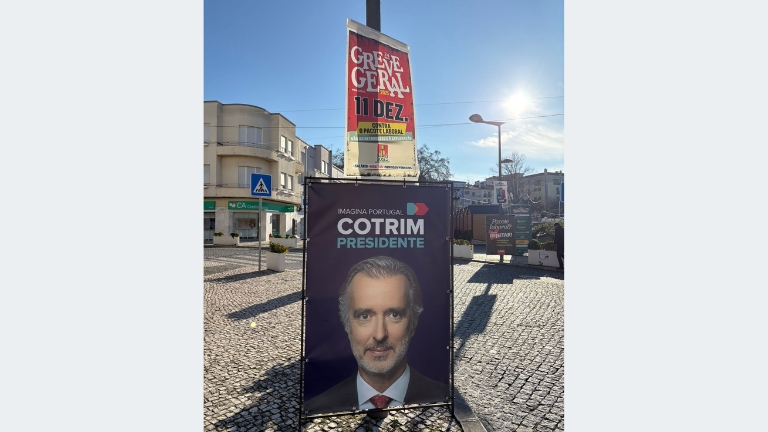
A presidential campaign billboard featuring João Cotrim de Figueiredo in Leiria, Portugal.
© Odilia AbreuOn January 18, 2026, Portugal held the first round of its presidential election. The center-left Partido Socialista (English: Socialist Party, PS) and its candidate, José António Seguro, emerged in first place but fell short of securing an outright majority. With no candidate crossing the 50% threshold, Portuguese voters are now headed to a runoff election scheduled for February 8. Seguro led the field with 31% of the vote and will face André Ventura, the candidate of the far right wing party Chega (English: Enough), who placed second with 23.5%.
While the headline figures point to a familiar runoff between Partido Socialista and Chega, the most significant story may lie elsewhere. João Cotrim de Figueiredo and the Portuguese liberal party, Iniciativa Liberal (English: Liberal Initiative, IL) have carved out a credible “third way”, overtaking the traditional center-right coalition Aliança Democrática (English: Democratic Alliance, AD), led by PSD (English: Social Democratic Party, PSD), and decisively reinforcing the liberals’ position in the political landscape. IL placed third with 16% of the vote, tripling their previous level of support from 5% from the parliamentary elections in May 2025. This marked the strongest presidential showing ever for Portuguese liberals and signaled a significant shift in the country’s political landscape.
For European liberals, and particularly the Freie Demokratische Partei (English: Free Democratic Party, FDP) in Germany, the Portuguese "liberal surge" offers valuable insights into how to maintain ideological clarity while achieving electoral expansion.
“Imagine Portugal”: Three Ideas, One Vision

Christmas postcards distributed during the campaign, targeting older voters, particularly in rural areas.
© João Cotrim de FigueiredoThe 2026 presidential campaign of João Cotrim de Figueiredo, current Member of the European Parliament, offers a compelling case study in how liberalism can be emotionally resonant, institutionally credible, and electorally expansive at the same time. Under the motto "Imagine Portugal", the campaign traded abstract theory for a visceral national vision. Rather than weaponising resentment, it invited citizens to take ownership of a more confident, prosperous future.
Operating within a polarised tripolar system, Socialists, the Democratic Alliance, and Chega, IL avoided marginalisation by positioning itself as the only rational, future-oriented alternative to both establishment inertia and populist radicalism. For liberals in Germany, this carries an important lesson: electoral relevance does not necessarily stem from numerical dominance, but from narrative authority.
The campaign’s architecture was built on exceptional message discipline, revolving around three core pillars, each condensed into a single word to create a powerful mnemonic device for the electorate. This '3C' strategy translated abstract liberal theory into a national vision:
- Culture (Cultura) – culture as civic confidence and national ambition, not identity politics;
- Knowledge (Conhecimento) – expertise and education as the foundation of real freedom;
- Growth (Crescimento) – economic growth framed as generational justice and social mobility, not privilege.
Presidential candidates in Portugal do not present detailed government programmes, but rather manifestos outlining values, principles, and strategic direction. This institutional design allows voters who may not identify strongly with a party to support a candidate based on personal credibility, constitutional restraint, and symbolic leadership. Cotrim de Figueiredo leveraged this framework effectively, distancing himself from day-to-day partisan conflict while remaining ideologically consistent.
Connecting Generations: The "Talk to Your Grandparents" Hybrid Campaign

“Talk to your grandparents,” a campaign initiative aimed at broadening support among older voters, highlighting intergenerational engagement through shared activities and video calls.
© João Cotrim de FigueiredoOne of the most innovative aspects of the campaign was its approach to the demographic “bubble.” While IL remains strongest among voters aged 18-34, the campaign clearly recognized that presidential elections are ultimately won in the heartlands, not only among digitally native audiences.
This strategy did not emerge by chance. The campaign’s three core ideas were easily adapted to the language of social media and deployed as soundbite-style messages across digital platforms. These ideas were reinforced by a highly personalised digital campaign that portrayed the candidate as accessible, active, and authentic. From cooking and running toward Palácio de Belém, the official residence of the President, to organising football matches with voters, riding a motorcycle, and participating in talk- shows- style formats, the campaign deliberately humanised the candidate and deepened his connection with younger audiences.
This insight is particularly valuable for German liberals, as it offers guidance on how to reactivate support among young voters, traditionally one of the FDP’s core strengths. This was clearly demonstrated in the 2021 Bundestag election, when the FDP achieved 23% of the vote among first-time voters, emerging as the strongest party in that group. Reconnecting ideological clarity with optimism, accessibility, and future-oriented narratives may once again prove decisive in mobilising this electorate.
For liberals, one of the persistent challenges has been reaching older voters. IL addressed this gap by deliberately untapping this often-overlooked potential through the “Fala com os avós” (“Talk to Your Grandparents”) strategy. The initiative mobilised young liberals as ambassadors within their own families and communities, encouraging grandchildren in particular to engage older relatives in political conversations. By facilitating video calls between the candidate and elderly voters, the campaign bridged the divide between digital-native optimism and more traditional forms of institutional trust.
This interpersonal strategy was reinforced by a large-scale offline effort. IL sent approximately 500,000 handwritten postcards to non-urban areas and older voters, each emphasising the importance of choosing the best option for Portugal’s future. Together, these tactics combined personal trust, family ties, and institutional respect successfully expanding liberal appeal beyond its traditional youthful base.
Staying Institutional Under Fire: How Liberal Crisis Management Reinforced Credibility

A presidential campaign billboard in Póvoa de Varzim, Portugal.
© Odilia AbreuCotrim de Figueiredo’s campaign was not immune to controversy, particularly at a critical moment when opinion polls briefly placed him in second position, potentially qualifying him for the runoff. At that point, allegations circulated on social media involving an alleged case of harassment linked to a former advisor associated with Iniciativa Liberal.
Rather than escalating the issue politically, the campaign responded with notable restraint and procedural discipline. The matter was formally referred to legal channels, and Cotrim de Figueiredo publicly clarified his position while filing a legal complaint to address the dissemination of unverified claims. This episode unfolded alongside an unusually aggressive media environment, including sustained critical coverage from outlets belonging to the Impresa group, which is often perceived as politically adjacent to the center-right PSD, the party most directly challenged by Cotrim de Figueiredo’s rise in the polls. While media scrutiny is a normal feature of democratic competition, the timing and intensity of the coverage contributed to a highly charged campaign atmosphere.
What stands out, however, is not the controversy itself but the way it was handled. The campaign’s response was consistent with its broader philosophy of Optimistic Institutionalism: respect for due process, confidence in legal institutions, and a refusal to weaponise outrage.
Liberalism Beyond Coalition Fatigue: Relevance for German liberals

Sports activities, including football, ping-pong, motorcycle rides, and running, were used as campaign tools to engage younger voters.
© João Cotrim de FigueiredoThe Portuguese case mirrors challenges currently faced by the FDP. Years of governing coalitions have bred a sense of fatigue, dulling enthusiasm and eroding political momentum. Into this atmosphere steps sustained pressure from right-wing populism, capitalising on frustration and uncertainty, and further narrowing the space for liberals.
Instead of reacting defensively or dissolving into technocratic coalition management, IL framed itself as the only future-capable alternative. This positioning reflects a core rule of political communication: A liberal campaign anchored in a small number of clear, repeatable ideas can outperform broader but less disciplined coalitions, especially in symbolic or consensus-oriented elections.
Insight for European Liberals: Reshaping Freedom
The Portuguese experience offers several transferable insights for liberal actors across Europe. Liberal politics does not fail because voters reject freedom; it falters when freedom is communicated as fragmented, abstract, overly technical, or defensive. This insight closely aligns with the concept of freedom articulated by Germany’s FDP at the Dreikönigstreffen in Stuttgart, where FDP General Secretary Nicole Büttner emphasised that “Freiheit ist kein abstrakter Begriff”. At the heart of liberal renewal lies precisely this task: unpacking freedom and unlocking its untapped political value.
Portuguese and German liberals are reshaping the idea of freedom, not as a defensive slogan, but as a coherent promise rooted in opportunity, responsibility, and institutional trust. In doing so, they are pointing the way forward for liberal parties across Europe.
This approach may prove particularly relevant for upcoming regional elections in Germany. In Baden-Württemberg, Dr. Hans-Ulrich Rülke, the FDP’s regional leader, has framed the contest as a fight for the “idea of freedom.” He has called for democratic self-defense against document-heavy bureaucracy that suffocates the Mittelstand—a line of argument strikingly similar to the one advanced in Cotrim de Figueiredo’s presidential campaign.
For the FDP and other European liberal parties, the message is clear: clarity beats complexity, optimism beats defensiveness, and ideas matter, especially when they are few, coherent, and oriented toward the future.
Odilia Abreu is a Senior Fellow at FNF Europe and a policy analyst specializing in migration, political diaspora, and liberal thought in Southern Europe. Her work focuses on the intersection of mobility, democratic governance, and regional integration, with particular attention to how diasporic communities influence electoral politics and policymaking across the EU. Odilia currently works as a freelance expert, advising organizations including FNF Europe in Brussels, where she provides analyses on political developments in Spain, Portugal, and Italy.